Denim has always been known as one of the toughest fabrics around, but lately it’s become one of the hardest-working too—and not just in your wardrobe. From beauty products to bedding, indigo tones are moving beyond fashion. Two months ago, Jeep brought back the iconic blue jean-inspired interiors they first launched in 1974 (in partnership with Levi’s at the time) for select Jeep Wranglers. Around the same time, interior designer Sarah Lederman launched a textile studio called Three Fates, featuring several indigo-infused fabrics and wallpapers that let designers wrap a room in deep, denim-like hues. A month earlier, in February, Chanel Beauty released a limited edition denim makeup collection to welcome spring. Has the world gone crazy for blue jeans?
The vintage Jeep denim interiors that inspired their new blue jean-upholstered Wranglers.
Photo: Courtesy of Jeep
Of course, denim is best known as a wardrobe staple. But the fabric wasn’t always used for clothing. “Before indigo became fashion’s most lasting blue, it actually belonged in the home,” explains Susan Clark, founder of the New York City-based design gallery Radnor. A longtime supporter of textile arts, Clark notes that indigo—the dye that gives denim its color—dates back 6,000 years and was once called “blue gold” because it was rare and precious, available only to royalty and the aristocracy. “Early indigo textiles were woven and hand-dyed for everyday life—furniture covers, bedding, and wall hangings that balanced practicality with a quiet, rich texture,” she adds.
A selection of indigo and jean-inspired fabrics by Sarah Lederman for Three Fates.
Photo: Sophie Fabbri
While many people associate denim with the American West (likely because Levi Strauss helped make blue jeans popular in the late 1800s from San Francisco), it’s worth noting that the roots of denim and indigo are far more global. “Indigo’s cultural reach is as wide as its history,” says Clark, pointing to its use in the ancient Mediterranean, India, Japan, Mesoamerica, and West Africa—long before the cotton twill fabric ‘serge de Nîmes’ was created in 17th-century France and the practical fabric ‘bleu de Gênes’ was made in Genoa around the same time, laying the groundwork for what would become modern blue jeans.
It’s this rich history that makes indigo and denim such a lively addition to any space. “Drawing on Japanese traditions, it always feels refined rather than cold, with a depth and subtlety that’s hard to achieve with other color schemes,” says Judith Harris, head of home at British clothing and homewares brand Toast, which has long used indigo and denim in its collections. “What ties these histories together is indigo itself: a material that goes beyond geography and time, constantly reimagined in art and clothing, from ceremonial to everyday use.”
Ralph Lauren Home’s spring 2026 Meadow Lane Collection.
Photo: Courtesy of Ralph Lauren Home
Today, indigo has found its way back into the home through creative uses of denim and dyed fabrics, leaving its mark in the airy rooms of beach houses and modern Manhattan high-rises alike. “A crisp, tailored denim can feel almost architectural on a sofa, while a softer, washed indigo feels more relaxed and textured,” says Ansley Majit, founding principal at Lark + Palm, who recently covered a kitchen banquette in heavy-duty indigo canvas and installed an oversized indigo sofa in two residential projects. “Coming from fashion, denim has always felt like a constant. It can be completely casual or incredibly polished, depending on how it’s cut, styled, and paired.”
A Manhattan apartment designed by Lark + Palm featuring denim upholstery.
Photo: John Merkl
American fashion brands like Ralph Lauren have long been known for their denim, so it makes sense that chambrays and indigos are staples in Ralph Lauren Home’s lifestyle collections. The brand’s spring 2026 Meadow Lane Collection carries that sensibility forward, celebratingCoastal living meets fabric design with weathered chambray, deep indigos, and airy sheers. (It’s worth noting that while chambray and denim look alike, chambray isn’t technically denim. Both use indigo dye and white cotton yarns, but chambray is a lightweight, breathable plain weave, while denim is a dense, heavy twill weave with diagonal ribbing.)
Indigo upholstery by Ralph Lauren Home.
Photo: Billal Taright
Another American brand, Citizens of Humanity, teamed up with Moda Operandi last year on a limited homeware collection that included denim napkins and placemats. “The collection was incredibly well received from the start and sold out almost immediately, showing just how strong the demand is for a broader denim lifestyle,” says Marianne Gallagher McDonald, the brand’s creative director, who designed the collection. Denim, it seems, works anywhere.
Denim napkins and placemats by Citizens of Humanity for Moda Operandi.
Photo: Courtesy of Citizens of Humanity
In recent years, many famous furniture brands have also added denim colors to their iconic designs. In 2024, Cassina relaunched the Soriana armchair—originally designed by Afra & Tobia Scarpa for Cassina in 1969—using premium Japanese denim from its archives. In March 2025, Knoll partnered with Supreme to release the Barcelona Chair and Ottoman with Japanese selvedge denim cushions and polished chrome details.
Cassina Soriana armchairs in various shades of denim.
Photo: Courtesy of Cassina
As people become more aware of the denim industry’s environmental impact and heavy water use, upcycling and reworking denim for interiors has become more common. At August West’s Bamboo House—a Horace Gifford-designed beach house on Fire Island that once belonged to her late grandfather—West and her art school collaborators combined pieces from 50 pairs of jeans collected from friends, family, and followers to create several furniture items. These included a daybed, pillows, ball pillows, placemats, coasters, decorative flowers, and even a lampshade. “It’s safe to say we went a little denim crazy,” West says with a laugh. “Denim is for everyone.”
The denim daybed at Bamboo House on Fire Island.
Photo: Patrick Cox
Upcycling denim has become even more popular for home goods. In April, Christina Kim, the legendary textile designer behind Dosa, released two styles of handmade, one-of-a-kind pillows for Commune. These pillows rework recycled denim pieces Kim has collected over the past 15 years. Toast also partnered with The Braided Rug Company on a limited collection, gathering waste denim to weave into circular rag rugs. Most recently, Toast worked with Vinterior to reimagine a 1960s oak armchair by Swedish designer Bröderna Anderssons, using blue and indigo fabrics with boro patchworking and sashiko stitching.
The Bröderna Anderssons x Vinterior denim chair.
Photo: Courtesy of Vinterior
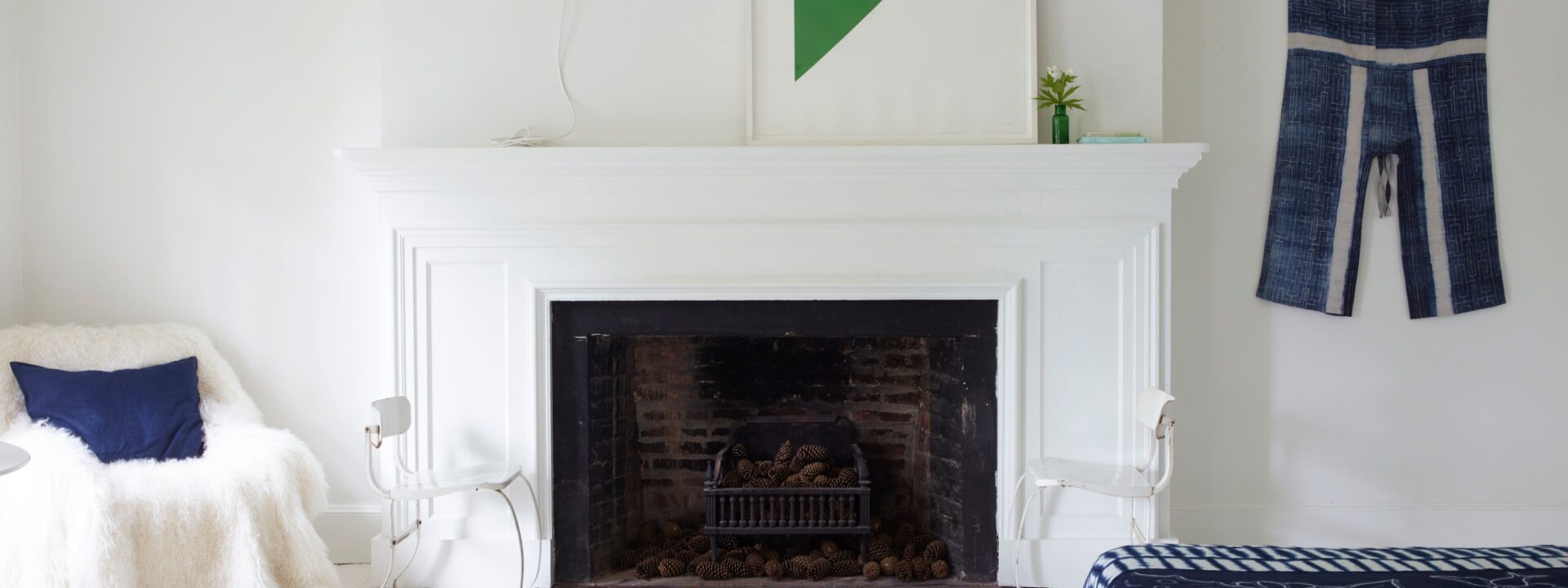
It’s not just denim—indigo has also found its way back into many people’s hearts and homes. David Mann of MR Architecture + Decor is an avid collector of indigo fabrics, which he uses in his home in Hudson, New York, as wall hangings and bed coverings. “These fabrics often carry history, culture, and patina,” he says. In his living room, two indigo-dyed linen sofas face each other. “Indigo brings a depth and moodiness to a space that softer neutrals often can’t,” adds Sarah Lederman.
Denim sofas at David Mann’s upstate home.
Photo: Simon Upton
Indigo also works beautifully in art. In early May, textile artist Rachel DuVall’s solo show Through Light and Matter opened at Clark’s craft gallery, Radnor, in Brooklyn. DuVall has used indigo in her work for the past 12 years and “finds the palette created from natural dyes to be harmonious.” She notes that “the variation possible with naturally dyed fibers adds richness and detail to the work” and that “natural colors” bring something special.and materials can feel incredibly grounding in the home.”
A work by Rachel DuVall at Radnor.
Photo: Courtesy of Radnor
If you want to bring the feel of denim or the calm of indigo into a room without using the fabric itself, you might consider paint or wallpaper. British paint company Graham & Brown offers a shade called “Boyfriend Jeans,” a dark blue with hints of gray, and their “Twill Denim” textured wallpaper mimics the look and feel of denim without needing the actual material. “I think people are drawn to the fact that it feels timeless and has presence, but is also easy to live with,” says Lederman of her indigo wallpapers and fabrics. “The indigo pieces have been some of the most quickly embraced in the collection,” she adds.
Most importantly, while denim-inspired spaces and indigo-filled interiors aren’t new, they don’t feel outdated. “What’s different now is the way it’s being reimagined,” says Majit. “It’s less about novelty and more about treating it as a legitimate textile, with the same care you’d give to a fine woven fabric.” Six thousand years later, indigo is once again “blue gold.”
Frequently Asked Questions
Here is a list of FAQs about using denim in interior design written in a natural tone with clear direct answers
Beginner Questions
1 What exactly is a denim interior
It means using denim fabricor its signature indigo blue color and rugged texturein your home decor This can be anything from an actual pair of jeans turned into a pillow to a sofa upholstered in new denim fabric or walls painted that classic blue
2 Is this just a trend or does it actually look good longterm
Its more of a classic style choice than a fad Denim is a neutral in the design world A dark indigo sofa or a denim throw blanket can look stylish for years much like a good pair of jeans never truly goes out of style
3 Wont denim make my room look like a teenagers bedroom
Not at all The key is how you use it A full denim sofa in a dark wash looks sophisticated and casualchic Avoid mixing too many different washes in one small space and pair the denim with elevated materials like leather wood or linen to keep it grownup
4 Whats the best way to start with denim decor if Im nervous
Start small Buy a few denim throw pillows for your couch a denim ottoman or a simple denim storage basket This lets you test the look without committing to a major piece of furniture
Advanced Practical Questions
5 What are the biggest benefits of using denim for upholstery
Its incredibly durable and softens with age without looking worn out Its also naturally stainresistant and easy to clean Plus it adds a unique cozy texture that cotton or linen cant quite match
6 What are the common problems with denim furniture
Color transfer is the biggest issue New dark denim can rub off on lightcolored clothing or walls Always buy prewashed or colorlocked denim for sofas Also cheap denim can pill or fade unevenly so invest in good quality fabric
7 Can I use real old jeans for home projects
Absolutely Upcycling is a brilliant idea You can make a patchwork rug a cushion