In 2025, PhotoVogue dedicated its Festival to exploring the relationship between humans and the ecosystems they inhabit. The goal was to create space for stories that challenge the idea of humans as separate from nature, instead presenting a perspective where humans are a species within complex, fragile ecosystems.
Spirit Bear Barney
This is Barney. It was the first known sighting of this Spirit bear within the Great Bear Rainforest. The tide was low, and he had climbed down a steep mountain to eat barnacles off the rocky shoreline. He was as interested in us as we were in him.
For over 38 years, Michelle Valberg has chronicled significant moments of national and international impact—from portraits and landscapes to her conservation work documenting numerous at-risk wildlife species. Known for her unique ability to create relatable images of unimaginable landscapes and wild creatures, Valberg finds art in nature’s most intimate moments. She was awarded the Order of Canada in 2022 and won the wildlife gold medal at the World Photographic Cup in Rome.
Follow Michelle on Instagram @michellevalbergphotography.
MICHELLE VALBERG / Courtesy of Vital Impacts
Ilulissat Icefjord, 2016
Tiina Itkonen / Courtesy of Vital Impacts
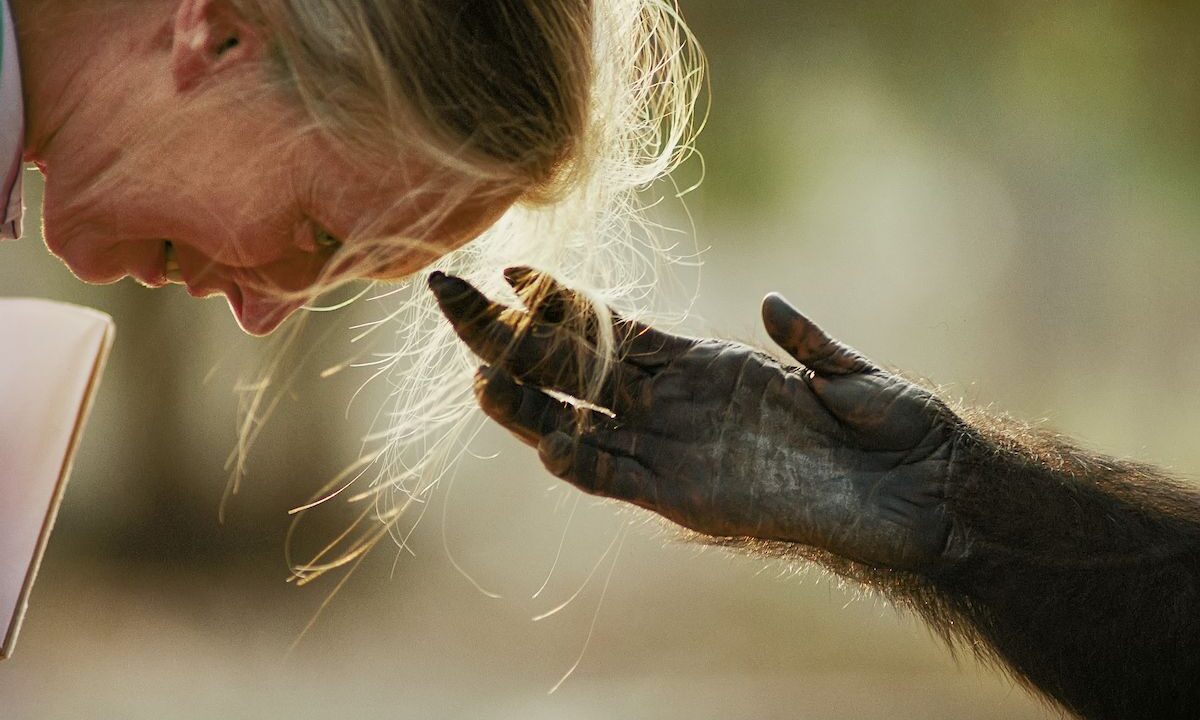
In the late 1980s and early 1990s, Dr. Jane Goodall, DBE, formed a deep bond with La Vieille, an elderly chimpanzee who had survived years of hardship at the Pointe Noire Zoo in the Republic of the Congo. Jane advocated for her rescue, helped secure support for her daily care, and later guided the creation of the Tchimpounga Chimpanzee Rehabilitation Center, where La Vieille could finally live in safety.
Michael “Nick” Nichols captured this quiet, unforgettable moment between La Vieille and Jane Goodall—a glimpse into the bond between a legendary scientist and the creatures she has devoted her life to. For Nichols, storytelling is epic in scale: his subjects range from lions and elephants to tigers and chimpanzees, but the human conservationists who dedicate themselves to these animals—Jane Goodall, J. Michael Fay, Iain Douglas-Hamilton, Craig Packer—are just as central to his narrative. His long friendship with Goodall has given him unparalleled access to her world, allowing him to capture her brilliance, compassion, and tireless devotion to the chimpanzees of Gombe. Raised in the woods of Alabama, Nichols joined National Geographic in 1996 and became Editor-at-Large for Photography in 2008, transforming every assignment into a story that is as visually breathtaking as it is emotionally resonant.
Michael Nick Nichols / Courtesy of Vital Impacts
The Stoat’s Game
That morning, the stoat performed a series of jumps on the snow for a few minutes that it had not done the previous days. It seemed to be playing with the freshly fallen snow, making sudden leaps and crawling through it.
Scientists have witnessed stoats (Mustela erminea) engaging in similar displays on many occasions, referring to the behavior as dancing, though their opinions are divided about what motivates the leaps and twists. Sometimes, the dances are performed in front of a rabbit or large bird in an apparent attempt to confuse or distract potential prey—a strategy that has proven effective in a number of documented interactions. At other times, as in the display photographed, there is no prey animal in sight, and the dance seems simply to be an expression of exuberance. A third hypothesis is that the dances are actually an involuntary response to a parasitic infection, since stoats are known to be hosts for cranial parasitic worms.
José Manuel has been a wildlife photographer for 25 years and specializes in birds. He has also worked on several studies on bird migration, which have been published in magazines such as Aedeola (SEO/BirdLife). José’s photos have received several awards, including in Wildlife Photographer of the Year, the GDT European Wildlife Photographer of the Year, and Nature’s Best Photography. He is a member of the Spanish Association of Nature Photographers.Photographers and the Spanish Ornithological Society. Follow Jose on Instagram @jm_grandio. Jose Manuel Grandio / Courtesy of Vital Impacts.
Today, on Earth Day—which also marks what would have been Jane Goodall’s 92nd birthday—we can reflect on this theme through the images of The Nature of Hope: The World Jane Goodall Inspired. This collection, created by Vital Impacts, features works by Nick Brandt, Frans Lanting, Cristina Mittermeier, Steve Winter, Ami Vitale, Jim Naughten, and others. For the occasion, a selection of rare, hand-signed prints by Jane Goodall is also available for purchase.
Dancing Elements
Aerial photograph of an Arctic river delta in autumn. Adventdalen Valley, Svalbard, Norway.
Orsolya Haarberg / Courtesy of Vital Impacts.
A World on the Edge
The Arctic is one of my happy places—its environment feels like another world. I had high hopes of encountering, photographing, and filming polar bears, but seeing them is never guaranteed, especially a polar bear on a glacier. Luckily for me, and believe it or not, my dream came true.
This photograph captures my first polar bear encounter. I couldn’t believe it—the timing, setting, light, and positioning were all perfect, with the added bonus of a waterfall! The toughest part was me, standing in a small zodiac as waves made it sway amid changing weather conditions. It took a prayer, a breath, and a second. I’m really happy with the result.
Michael Haluwana is an internationally acclaimed, award-winning cinematographer, photographer, and videographer with over 17 years of industry experience. His exceptional work has earned him accolades from prestigious organizations such as National Geographic, BBC, Virgin Galactic, Canon, and Sony. Michael has collaborated with esteemed professionals on iconic projects worldwide, notably working alongside Sir David Attenborough on BBC’s Planet Earth II and Planet Earth III, contributing to the stunning visuals that have captivated audiences globally.
Follow Michael on Instagram @aeroture_aus.
Michael Haluwana / Courtesy of Vital Impacts.
Blue-footed Booby
Blue-footed Booby (Sula nebouxii) in the Galapagos, Ecuador.
Tui De Roy is a world-renowned wildlife photographer and author based in the Galapagos Islands, traveling widely under the motto: “Images of wildlife and wilderness from our planet’s most pristine, uninhabited regions.” With over 20 published books, her work has appeared in more than 40 countries.
Follow De Roy on Instagram @tuigalapagos.
Tui De Roy / Roving Tortoise Photos / Courtesy of Vital Impacts.
Horseback Rider Mongolia
A young horseback rider in Mongolia.
Chiara Goia is a photographer whose work spans documentary, editorial, and commercial projects, while always maintaining a focus on her personal work and artistic research.
Follow Chiara on Instagram @chiaragoia.
Chiara Goia / Courtesy of Vital Impacts.
Badlands National Park
Badlands National Park covers 244,000 acres. While visitors can enjoy animals like bison, prairie dogs, and bighorn sheep, I was captivated by how the park is chiseled with deep red layers of rock, colored by oxidized iron. Looking out over the park after sunrise, seeing layer upon layer of rock topped with a touch of red and prairie land nestled within, I’m glad I took a few minutes to stop and let the spectacular view sink in.
My name is Dawn D. Hester from Pace, Florida. I am a retired photographer who now shoots and enjoys the adventures along the way. I recently started a project on tree roots. I’ve always been fascinated by roots and how they grow far from the tree in unique ways. Lately, I’ve become more interested in their purpose—not just for the tree itself, but how important they are to animals and their survival. With climate change, this can become a major factor in some areas.
Follow Dawn on Instagram @dawndhester.
DAWN D. HESTER / Courtesy of Vital Impacts.
All proceeds from sales support Jane Goodall’s Roots & Shoots program and Vital Impacts.Vital Impacts Fellowships support young people who are creating meaningful change for people, animals, and the environment. In times when it’s easy to lose hope and give in to cynicism or eco-anxiety, Vital Impacts shares images that remind us fighting for our planet is possible—and that we can do it with joy.
Rajan Morning Walk
This is Rajan, a 66-year-old Asian elephant and the last of his kind. He was brought to the Andaman Islands for logging in the 1950s, where he and a small group of ten elephants were forced to learn how to swim in the ocean to move logged trees to boats and travel between islands. When logging was banned in 2002, Rajan was out of a job. He spent his remaining years peacefully among the giant trees he once hauled in India’s Andaman Archipelago. Rajan was the last survivor of his group until his death in 2016. This image is from the artist’s series “The Last of His Kind.”
Award-winning photographer Jody MacDonald is no stranger to adventure and exploration in the planet’s last untamed corners. Follow Jody on Instagram @jodymacdonaldphoto.
Jody MacDonald / Courtesy of Vital Impacts
A moment captured by Dr. Jane Goodall, DBE, Founder of the Jane Goodall Institute and UN Messenger of Peace.
Dr. Goodall says, “This photo is of Fifi’s first grandchild, Fax, son of daughter Fanny. It was taken in 1993.” Dr. Goodall is a world-renowned ethologist and activist who inspires greater understanding and action on behalf of the natural world.
Jane Goodall / Courtesy of Vital Impacts
Kings of the Kelp
King Penguins fly through a Kelp Forest.
Capturing king penguins swimming through dense kelp forests in the remote sub-Antarctic was a thrilling challenge. The journey was difficult, navigating treacherous currents and unpredictable weather. Yet, seeing the penguins move gracefully through the kelp was stunning. Using a rebreather, I observed them unobtrusively as they flew through the forest. These majestic birds, perfectly adapted to their environment, moved with a grace that belied their size.
This photograph highlights the delicate balance of marine ecosystems, showing the beauty of king penguins in their natural habitat and underscoring the importance of preserving these unique underwater forests. It captures a moment of pure wildlife behavior, a testament to resilience in one of Earth’s most extreme environments. I hope it inspires awe and a deeper appreciation for protecting these ecosystems from climate change and human interference.
Kimberly Jeffries is an underwater cinematographer and photographer based in Hawai’i, known for her work in marine conservation and diving. Her focus is on protecting the ocean’s fragile ecosystems and uplifting the female voice. Her passion for marine conservation is reflected in her work, featured in documentaries, films, and publications. She has collaborated with National Geographic, Discovery Channel, and Netflix.
Follow Kimberly on Instagram @kimberlyswimberly.
Kimberly Jeffries / Courtesy of Vital Impacts
Mineral Matter III
Mineral Matter explores the interplay between Iceland’s dynamic river deltas and traces of human curiosity.
Volcanic ash, sediment, and colorful minerals are carried by powerful glacier water, while recent human traces like vehicle tracks and footsteps weave through the frame. From above, painterly folds of watery texture and vibrant sediment create graphic compositions visible only from the sky.
BROOKE HOLM 2017, BROOKE HOLM 2014 / Courtesy of Vital ImpactsIn the pale light of a Canadian winter morning, a Snowy Owl rises into the Arctic air. Its broad wings and thick feathers carry it almost silently—a quiet symbol of resilience and the stark beauty of the North.
Arnfinn Johansen
Orphan Chimps, Tchimpounga Sanctuary, Congo, 1995
Caretaker Ludovic Rabasa acts as a surrogate parent to more than fifty orphaned chimpanzees. Each day he plays with the infants, helping them develop social skills they would normally learn from their families in the wild. These chimpanzees can live over fifty years, but they cannot be safely released into areas with humans or wild chimps.
Michael Nichols / Courtesy of Vital Impacts
Fluctus #33
Fluctus is a project that captures biodiversity in a unique way, focusing on the very first wingbeats of birds seen from above. This perspective highlights the richness, beauty, and variety of common birds that live around us—species we often overlook. For me, the project also emphasizes the importance of keeping these bird populations healthy.
To create these images, I’ve spent many days in the field with ornithologists during bird-ringing campaigns. Their work is essential—it helps monitor bird populations and provides the scientific data needed to alert the public and governments when action is required. With their knowledge and collaboration, I’ve been able to film these birds by setting up a temporary studio just as they are released.
What gives me hope is this connection between science, care, and wonder. Seeing these small, everyday birds up close reminds me that nature’s diversity is still all around us, and that paying attention is the first step toward protecting it.
Xavi Bou / Courtesy of Vital Impacts
Frequently Asked Questions
FAQs Celebrating Earth Day Through the Lens of Environmental Photographers
Beginner General Questions
1 What does an environmental photographer actually do
Environmental photographers use their cameras to document the natural world wildlife and the relationship between humans and the environment Their work aims to tell stories about conservation climate change and the beauty of our planet often to inspire action and awareness
2 How can photography help celebrate Earth Day
Photography makes the abstract real A powerful image can instantly communicate the splendor of a landscape the plight of an endangered species or the impact of pollution in a way words alone cannot Sharing these images on Earth Day spreads awareness and fosters a deeper connection to the planet
3 Im not a professional How can I participate
You dont need fancy gear Use your smartphone The goal is to observe and share Photograph a local park a blooming flower a community cleanup or even a problem like litter Share it with a caption about what Earth Day means to you The act of looking closely is a form of celebration
4 Who are some famous environmental photographers I should know
Some leading names include
Paul Nicklen Cristina Mittermeier Renowned for marine conservation storytelling
James Balog Famous for longterm projects documenting glacial melt
Frans Lanting A master of wildlife and landscape photography that conveys ecological narratives
Ami Vitale Focuses on wildlife and communities living alongside them like her work with pandas and rhinos
Practical Technical Questions
5 What makes a photo environmental and not just a pretty landscape
While beauty is important an environmental photo often has a narrative or a message It might show contrast document change over time highlight an environmental issue or intimately portray a species in its habitat to build empathy
6 Whats one key tip for taking better nature photos on Earth Day
Pay attention to light The golden hoursjust after sunrise and before sunsetprovide soft warm dramatic light that brings landscapes and subjects to life Harsh midday sun often creates flat unflattering images