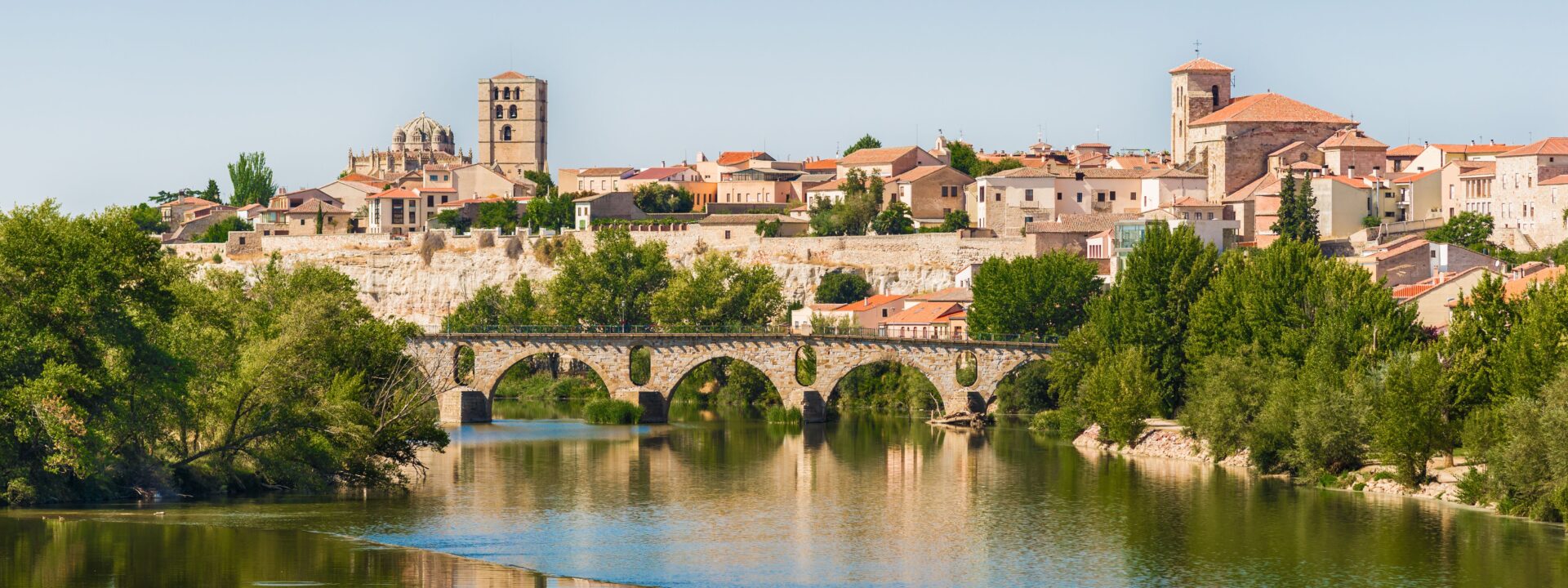
For those in the know, Spain’s northern region of Castile and León has long been a favorite weekend escape for food-loving Madrileños. They make the pilgrimage to eat morcilla de Burgos (blood sausage) at the famed roadside restaurant Landa or to tuck into crisp-skinned cochinillo (roast suckling pig) at Segovia’s venerable Mesón de Cándido. After all, this vast autonomous community—the largest in Spain, spanning nine provinces including Salamanca and Valladolid—is one of the great cradles of Spanish gastronomy. It produces famed products like jamón de Guijuelo (among the country’s most prized Ibérico hams), creamy judiones de La Granja beans, and queso Zamorano (a hard sheep’s-milk cheese often compared to Manchego).
Yet among international travelers, this pastoral heartland has never inspired the same foodie fantasies as the Basque Country or Catalonia. “I think our identity has been greatly diluted in the national imagination,” says chef Anai Meléndez of Valladolid’s hotspot Caín. “Much of inland Spain is seen as a homogeneous mass with Madrid at its center, leaving only the peripheries to claim an independent narrative.”
That narrative is finally shifting. Meléndez is part of a wave of chefs returning home from Madrid, Barcelona, and other established culinary centers to reclaim the region’s gastronomic heritage. These young chefs are opening destination-worthy restaurants in storybook towns, turning humble stews, roasted meats, and local Ribera del Duero wines into expressions of contemporary Castilian pride. “Things are happening in very small places that nobody used to pay attention to,” says Pablo González of La Trébede, a modest country restaurant that earned Michelin buzz within a year of its debut. “A new cuisine is being born here—one that honors what came before. I have the feeling Castile and León will soon be a global reference.”
Happily for travelers, many of the region’s most exciting openings are unfolding inside design-forward independent hotels. In Salamanca, celebrated chef José Manuel Pascua has transformed a 19th-century palace into Eunice Gastronomic Hotel, the city’s first chef-owned boutique stay. Here, mornings begin with a multi-course tasting breakfast and end with dinner at the pilgrimage-worthy Pascua restaurant. Over in Ávila, La Casa del Presidente—the former summer retreat of Spain’s first democratically elected prime minister, Adolfo Suárez—is emerging as one of the country’s top gastro-hotels, thanks to Caleña, a buzzy new restaurant from twenty-something chefs Diego Sanz and Cristina Massuh.
With Six Senses set to debut its first mainland Spain property in Ávila in 2026, now is the moment to plan a culinary deep dive through Castile and León before the rest of the world catches on. Below, find the best new restaurants and standout hotels to add to your itinerary.
Where to Stay
Eunice Gastronomic Hotel
Salamanca’s first design-forward, chef-owned boutique hotel, Eunice Gastronomic Hotel is the vision of celebrated local chef José Manuel Pascua. He rose to fame after rebooting nearby Bambú Tapas & Brasas—the beloved Salamanca restaurant his grandmother founded in the 1980s. In March 2024, Pascua turned to hospitality with the launch of a 13-room property set inside a 19th-century palace adjacent to the Plaza de Monterrey. The intimate, jewel box–like interiors are filled with artwork by Iberian heavyweights, including Catalan sculptor Jaume Plensa and Portuguese artist José Pedro Croft, plus textiles decorated with traditional embroidery from the Sierra de Francia.
“This hotel is an homage to the generation of women my grandmother belonged to, who worked to provide stability, comfort, and security to their families,” explains Pascua.
At the center of the pThe property features a serene courtyard garden designed by Madrid-based studio Benavides Laperche, known for collaborations with firms like Herzog & de Meuron and Lázaro Rosa-Violán Estudio. It’s a tranquil spot to relax before or after enjoying the tasting menu or à la carte options at Pascua, a fine-dining restaurant focused on “purist,” seasonal dishes. These highlight evolving flavors such as buttery Swiss chard, rabito de cerdo, Iberian pork shoulder, and sobrasada ibérica. While it’s tempting to overindulge, be sure to arrive hungry in the morning: the hotel’s lavish breakfast—served in a bright dining room centered around a restored antique kitchen—has become one of the most talked-about meals in town. Silver platters are piled high with Salamanca pastries like bamba de nata and bollo maimón (sponge cake), along with fresh fruit, yogurt, homemade granola, and an array of homemade jams.
La Casa del Presidente
Photo: Maximiliano Polles
Once the home of Spain’s first democratically elected prime minister, Adolfo Suárez, La Casa del Presidente is one of Ávila’s most regal retreats. Secret trapdoors, cozy seating areas lined with books and 19th-century French furniture, and manicured gardens maintain the feel of a politician’s private residence. The best rooms overlook the town’s UNESCO-protected medieval wall and feature luxuries like Loewe quilts, claw-foot tubs, and Eight & Bob bath products—a line known for an eau de toilette favored by John F. Kennedy, a detail staff often mention to help foreign guests connect with Suárez’s legacy. In summer, the place to be is the standout outdoor pool, which offers views of the ancient walls and a small chiringuito serving beach-style drinks and snacks.
The hotel’s centerpiece is Caleña, a fine-dining restaurant launched in November 2024 and awarded a Repsol Sol within its first six months. Led by 25-year-old chef Diego Sanz, who trained in Michelin-starred kitchens including Copenhagen’s Noma, alongside 29-year-old Cristina Massuh, the glass-walled dining room serves the region’s famous spoon dishes, stews, and pickled preparations. Think Chinese eggplant with jowl and pico de gallo, or an exquisite Castilian-style carbonara made with green beans instead of noodles, torrezno from Ávila, and Canto Viejo cheese. It’s destined to become one of Spain’s great restaurants, so book now while you still can.
Landa
Photo: Courtesy of Landa
For many Spaniards, it’s unthinkable to drive north from Madrid along the A-1 highway—one of the country’s major north-south routes—without stopping for a meal at Landa. This famous roadside restaurant and hotel has hosted VIPs like Audrey Hepburn, Brigitte Bardot, and King Juan Carlos. Now welcoming its fourth generation of clients, Landa is renowned for elevating the local delicacy, morcillas de Burgos (black pudding), to a place of honor. “Before then, it had been relegated to a side dish in the classic Castilian stew olla podrida,” explains Guzmán Alameda Landa, whose grandfather Jesús Landa and Burgos-born grandmother, Carmela Vicente, founded the restaurant in 1959.
Beyond the sprawling restaurant, the 35 guest rooms have a regal feel, thanks to their setting in a 14th-century tower relocated from the nearby town of Albillos to the Landa property. Designed by Spanish interior designer Pascua Ortega, the antique-filled guestrooms combine botanical wallpaper, four-poster beds dressed in linen sheets (washed and ironed at the Royal Monastery of Las Huelgas), and clawfoot tubs. While technically a roadside stop, the dreamy gothic-inspired swimming pool—with its colonnaded ceilings and ornate glass windows—might just make you reconsider the rest of your itinerary.
Casa Taberna
Photo: Courtesy of Casa Taberna
Located inside the centuries-old tavern on Pedraza’s main square, this four-room gastro-hotel is the passion project of S—Spanish chef Samantha Vallejo-Nágera, known for MásterChef, along with her French-born mother Sabine Déroulède and sister Mafalda Muñoz, an interior designer, have preserved the building’s original beams, clay tiles, and stone walls. They’ve added 17th-century mirrors, custom furniture from Madrid-based Casa Muñoz, Louis XIII armchairs, and jute rugs. Some rooms overlook Pedraza’s medieval square, while others offer sweeping views of the Guadarrama Mountains.
The hotel’s atmospheric tavern feels like a step back in time, with classic bullfighting posters on whitewashed plaster walls, rustic wooden furniture, and wrought-iron wall sconces. It’s the perfect setting for hearty dishes like pork cheek cannelloni or cheese flan brûlée. For breakfast, enjoy Lenôtre pastries before heading out on a concierge-organized activity, such as horseback riding or a day with a local shepherd.
Where to Eat
Barro
In 2024, chef-owner Carlos Casillas made history as the youngest Spanish chef to receive a Michelin star at just 25. Born in Ávila, Casillas trained at the Basque Culinary Center and later returned home with culinary-school colleagues to open Barro in a 250-year-old flour mill on the banks of the Adaja River, just outside the city’s UNESCO-listed walls. “Our generation had the chance to train elsewhere,” Casillas says. “There is always the option to come back and reinvest that value in the place you are from.” The dining room, with its adobe tones and vaulted wooden ceiling beams, feels like a warm country manor.
Two tasting menus feature contemporary Castilian cooking highlighting ingredients from over sixty local producers, while the wine list includes about 1,180 labels, with a focus on bottles from Ávila. A signature dish, Campo Amarillo (“Yellow Field”), pairs tender local rabbit with buttery legumes, nodding to Spanish poet Antonio Machado’s “Campos de Castilla.” After dinner, guests can visit the subterranean Fango Bar for cocktails. The team has also opened Sucro on-site, offering relaxed, locally inspired dishes and a selection from a cellar of over 1,000 bottles, emphasizing Garnachas from the nearby Gredos range.
Ricardo Temiño
Chef Ricardo Temiño trained with the legendary Paul Bocuse and traveled from Lyon to Tokyo in search of culinary inspiration before opening his celebrated La Fábrica in his hometown of Burgos. His new restaurant earned a Michelin star within a year of opening and draws on stories of pilgrims who have passed through the Castilian city along historic routes like the Camino de Santiago, the Route of El Cid, and the lesser-known Paprika Route of Christopher Columbus.
The experience begins in the subterranean wine cellar, home to about 400 labels and nearly 2,000 bottles, where guests sip vermouth cocktails and watch Temiño prepare appetizers such as a traditional suckling-lamb skewer with candied red pepper and a pâté en croûte with a Burgos twist—featuring ear, snout, foie, blood sausage, dried apricots, and pistachios. After touring the open kitchen and meat-maturation room, guests are seated in the dining rooms, once a hostel for pilgrims, and treated to two different tasting menus. A highlight is the suckling lamb, served in two courses: first, a suckling-lamb “royal” with a liquid salad (blended lettuce and tomato hearts); second, 15-day aged lamb loin served with textures of beetroot, sorrel, and a reduced lamb rib sauce.
Caín
Pushed out of Madrid by gentrification, chef Anai Meléndez returned to her hometown of Nava del Rey (population 2,000) in Valladolid to open a restaurant centered on charcoal grills and local produce. The soaring dining room is punk-inspired.The setting is ecclesiastical with a twist: dark walls, exposed stone, chains hanging like church arches, accents of blood-red, and a large golden disc reminiscent of an altar screen. It’s an irreverent, free-spirited backdrop for tender cuts cooked over embers—like lamb lashed to a cross-shaped stake and slow-roasted on a spit for five hours—or traditional dishes reimagined, such as pardina lentils with pickled partridge. The wine list shines, featuring exclusively producers from Castile and León, 95% of which are small, family-run wineries focused on low-intervention wines.
Trebede
Though it sits just off the A-6—the highway linking Madrid with Galicia through Castile and León—the Castilian hamlet of Pobladura del Valle had long been overlooked by travelers. That changed in 2024 when 23-year-old chef Pablo González opened this refined tavern restaurant on the village outskirts, drawing VIP guests like Madrid’s regional leader Isabel Díaz Ayuso and even catching the eye of the Michelin Guide.
Trained at the Basque Culinary Center and having worked in Michelin-starred kitchens in the region, González describes the food of Castile and León as “intense, honest flavors.” In his kitchen, those flavors come from sustainably sourced ingredients: game from Tierra de Campos, wine from El Bierzo, mushrooms from Sanabria, cheese from Zamora, and trout from León. “It’s cooking without artifice, with respect for the people who work the land and care for the animals,” he says. Settle into the warm, inviting dining room—decorated with farm tools, a pitched wooden ceiling, and a crackling fireplace—and enjoy dishes like Leonese-style black pudding with pine nuts and Reinette apples, duck micuit with fig jam, and confit pig’s ear with a sun-dried tomato and mussel salsa brava.
Frequently Asked Questions
Of course Here is a list of FAQs about Castile and León as an emerging culinary destination designed to sound like questions from curious travelers and food lovers
Beginner General Questions
Q Where exactly is Castile and León
A Its a large landlocked region in northwestern Spain Its famous for historic cities like Salamanca Segovia Ávila and León and sits right north of Madrid
Q Ive heard of Spanish food but whats so special about this regions cuisine
A Its known for its hearty rustic and flavorful dishes built on incredible local ingredients roast meats legumes fresh river fish and worldclass wines Its less about coastal tapas and more about deeply satisfying meals that reflect its agricultural heartland
Q Whats the one dish I absolutely have to try
A Cochinillo Asado from Segovia is legendary Its roasted in woodfired ovens until the skin is cracklingcrisp and the meat is incredibly tender
Q Is it just meat and potatoes
A Not at all While roasts and stews are stars theres huge variety delicate river trout famous Judiones de la Granja amazing cheeses like Zamorano sheeps cheese and an incredible array of pulses and vegetables
Q What about wine Is it a good region for that
A Absolutely Its home to Ribera del Duero one of Spains most prestigious wine regions famous for powerful oakaged reds made from Tinto Fino Also look for wines from Rueda and Toro
Advanced Practical Questions
Q Why is it considered overlooked and emerging now
A For years tourists focused on coastal areas or major cities Now travelers seeking authentic lesscrowded experiences are discovering its depth A new generation of chefs is also creatively reinterpreting traditional recipes gaining national attention
Q Beyond the suckling pig what are some other iconic dishes
A Look for