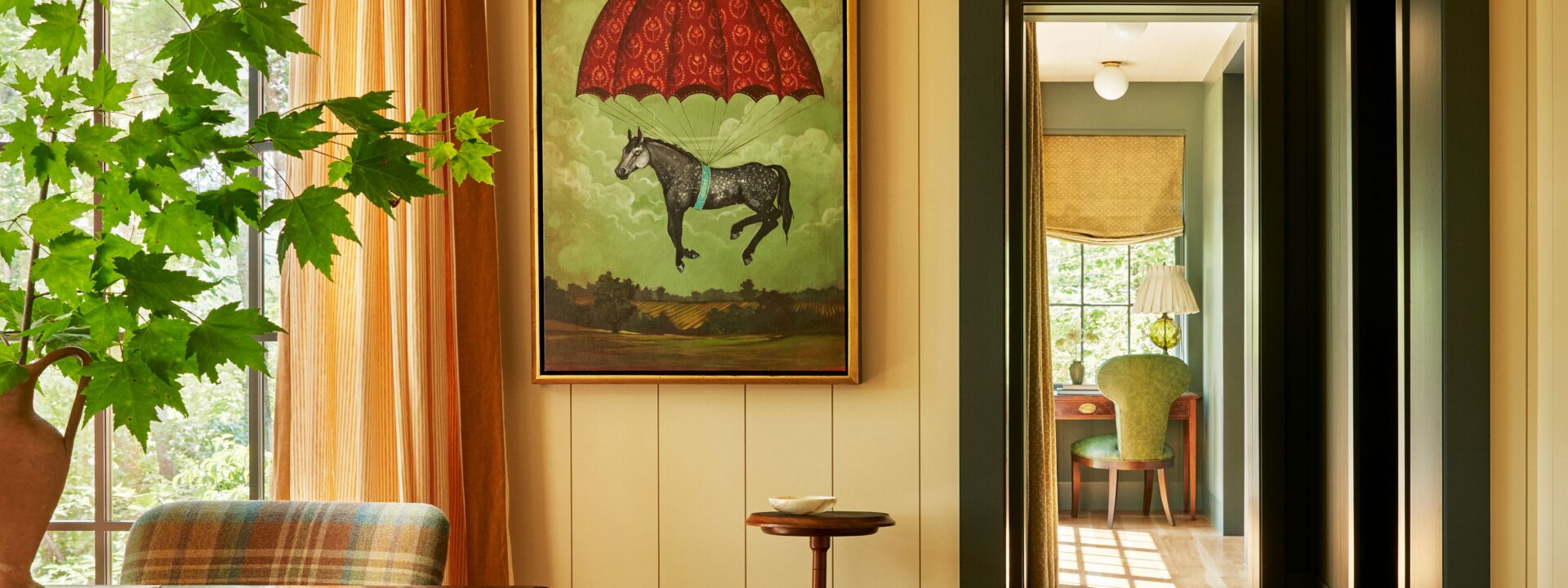
In a world where technology seems to have a tight grip on society, it’s easy to think that everything can be done with a tap, swipe, or AI prompt. But when it comes to designing a comfortable home, experts say: not so fast. While some people love the personal touch of hand-painted murals or a carefully arranged plate wall, more and more are skipping the smart home in favor of a simpler setup. Goodbye, smart devices and Bluetooth everything. Welcome back, basic appliances and manual systems.
Call it what you like—”dumb homes,” “analog interiors,” or “lo-fi spaces”—but many people are longing for a simpler time. Before screens and Siri, to be exact. For Bari Jerauld, founder of Blank Slate Studio, this shift is a “response to overstimulation.”
“We spend so much of our lives on screens and in fast-moving digital environments, so the home has become the one place people desperately want to feel the opposite,” the London-based designer explains. “People are asking for warmth, character, and rooms that feel like they have a history.”
A low-key entryway by Blank Slate Studio—no wall screens in sight.
Photo: Courtesy of Blank Slate Studio
In fact, Jerauld says she first noticed the rise of analog interiors when her clients started asking for spaces with a more low-tech feel. Thomas Jayne, an interior designer in New York City, agrees. “My clients are saying, ‘I just want to turn on one switch to turn on my lights,'” he says. “They don’t want to have to go to a computer and program and push.”
While a full smart-home system seems to offer control at your fingertips, Dr. Sally Augustin, PhD, an applied environmental psychologist, says otherwise. “Having to override the lighting system, for example, makes you feel less in control and is a hassle,” she says. “We’ve all had our laptops crash, and smart systems can also misbehave. If your home is highly automated, you live under a cloud of potential failure.”
A high-tech home that rivals Tony Stark’s superhero hideout might impress guests, but Augustin says these spaces often create a lonely atmosphere. “People are social animals,” she explains. “They really want to interact.” Designing a home around screens, she says, takes away “the richer conversation we used to have.” “If someone has a question today, they pull out their phone and Google the answer.”
Venetia Rudebeck, co-founder of Studio Vero in London, says clients love the connectedness of old-school spaces. “A lot of the trend is being driven by families,” she adds. “Parents are much more aware of how much time is spent on screens, so they’re actively trying to change that.”
Plus, there’s the nostalgia factor. Think of an analog interior as a trip down memory lane to the good old days—and even better vibes. “When those positive memories come to mind, our mood improves, which means our cognitive performance improves,” Augustin shares. “Our ability to get along with others does as well.”
The key, according to Houston designer Emily Spanos, is to find a balance between “nostalgic” and “now.” “We can’t go off the grid and have no tech in our houses, especially because lots of people work from home,” she explains. “I think back to the ’80s and ’90s, where there wasn’t this constant stream of being connected.”
A vintage radio anchors a corner designed by Emily Spanos.
Photo: Claudia Casbarian
Spanos loves to create a “drop zone” near a home’s entryway to help people set aside extra screens. “[My clients] can put their phones there, let them charge, unplug, and really focus on their family,” she says. “You can have an appliance garage with chargers or just a big basket where everyone puts their stuff.”
With smartphones and tablets out of the way, Spanos adds lo-fi aAlternatives like a landline or a corded phone are popular with families with young children, she says. “It’s a cool idea for kids,” she adds. “It’s attached to the wall, so you really have to focus on the conversation instead of doing ten different things on your smartphone.”
Rudebeck likes to swap the multi-monitor home office for a simple writing desk, a style that goes back to medieval times. “It’s not just functional, it’s a ritual,” she explains. “In a world where everything happens on a phone, having a place where you physically sit—even for a short time—feels important again.”
A writing desk setup, with no screens in sight, by Studio Vero. Photo: Simon Brown
Instead of making the living room the main focus of your home—and pointing all your seating toward a big TV—Rudebeck suggests creating cozy spots for activities that don’t involve screens. “We’re working on at least four projects right now where clients have specifically asked for spaces that encourage reading, writing, playing games, doing puzzles with their kids, or just sitting and talking,” she says. “That might include a chalkboard wall that can be constantly changed, a pool table for teenagers, or a beautiful stack of books that invites you to pick one up.”
Rearranging space and adding classic furniture is important, but don’t overlook the small details. For example, Samantha Feuer of Noris Studio likes to skip modern recessed lights. “Layers of lighting are so important to a home,” the Mayville, Tennessee designer explains. “Add surface-mounted fixtures, lamps, and wall sconces.” For a timeless finishing touch, Feuer prefers controlling lights with rotary dimmers and toggle switches. Speaking of which, she strongly recommends sticking with standard outlets. “Is it USB or USB-C?” she asks. “Who knows if it’s going to change again. If you’ve already put something in the wall, you’ll just have to pull it out again.”
Beyond hardware, Augustin suggests adding curved furniture and décor, which bring back the comfort of the past, while Jayne says a handmade rug can “change a space almost immediately.”
“Dumb” homes might be trendy right now—but will they last? Absolutely, designers insist. Feuer points out that analog touches are actually more cost-effective than upgrading your home’s technology every few years. “You can’t keep up with it,” she says. “Things in a smart home break or stop working with newer technology. If you have simple switches and simple outlets, and things don’t break as easily, it’s timeless.” And let’s be honest—classic never goes out of style.
Frequently Asked Questions
Here is a list of FAQs based on the premise that Your home is getting dumberand thats actually a good thing
General Definitions
Q Wait isnt smart technology supposed to be the future Why would I want a dumb home
A We arent talking about removing technology Were talking about removing complexity A dumb home in this context means a home that uses simple reliable technology that works automatically without needing an app a WiFi connection or a subscription Its about convenience through simplicity not artificial intelligence
Q What exactly is a dumb home in this new sense
A Its a home that focuses on setandforget technology Think of a mechanical timer for your lights a smart thermostat that learns your schedule without you opening an app or a smart lock that just opens with your fingerprint The tech is there but the thinking and the fiddling are removed
Q How is this different from a smart home
A A traditional smart home usually relies on a central hub and an app to control everything A dumb smart home uses devices that are intelligent on their own They operate based on sensors schedules or simple physical inputs so you dont have to manage a complex network of connected devices
Benefits The Good Thing Aspect
Q Why is having a dumber home a good thing
A Because it gives you back your time and peace of mind You dont have to troubleshoot why your lights wont turn on because the WiFi is down or worry about a cloud service being hacked Its reliable private and actually saves you money because the devices are usually cheaper and last longer
Q What are the main benefits of simplifying my home tech
A The big three are Reliability Security and Sanity
Q Will I have to give up cool features like voice control