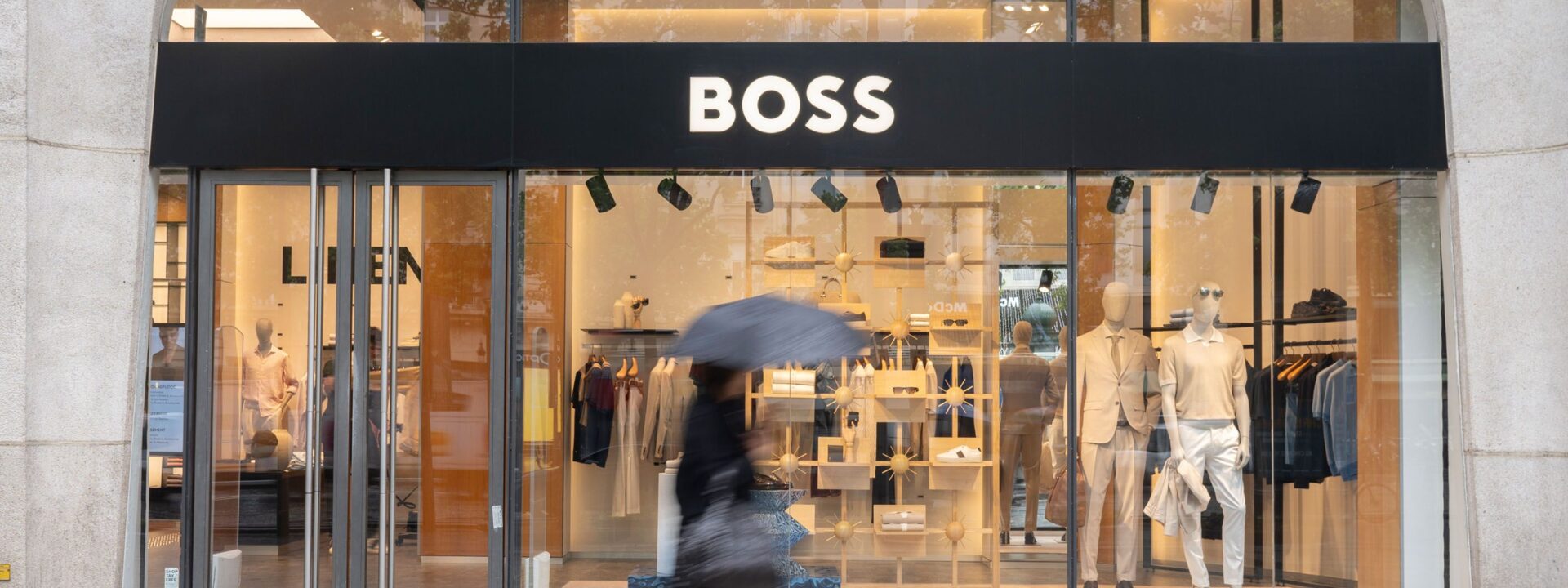
Daniel Grieder doesn’t get rattled easily. When the Hugo Boss CEO stepped onto the stage at a luxury retail conference in Abu Dhabi back in January, he spoke openly about the challenges the German fashion group was facing. China was still tough. Womenswear hadn’t reached its full potential yet. And after four years of fast growth following a major brand overhaul, the momentum was starting to fade.
Five months later, Hugo Boss is back in the spotlight. Last week, its biggest shareholder, Frasers Group, announced plans to make a takeover bid for the company. This has put renewed focus on a business whose transformation is still very much a work in progress.
Read More
Inside the big Hugo Boss rebrand
Hugo Boss CEO Daniel Grieder is leading a complete makeover of the company, from marketing to design. In short? Boss is for millennials, Hugo for Gen Z.
By Lucy Maguire
The timing is worth noting. Hugo Boss is no longer the brand Grieder took over in 2021. Sales have doubled, and the company has moved into the next stage of its Claim 5 strategy, which focuses on building brand value and improving profitability. Unlike Frasers’ pursuit of British handbag brand Mulberry in 2024, this proposal isn’t being framed as a rescue mission. Frasers has publicly backed Grieder’s direction. Hugo Boss responded with a measured statement, saying it would review any formal offer and act in the best interests of shareholders, employees, and customers.
If the deal goes through, the question isn’t whether Hugo Boss needs a new strategy — it’s whether full ownership by Frasers would help finish the one already in motion.
From great to excellent
When Grieder joined from Tommy Hilfiger in 2021, he argued that Hugo Boss had lost its relevance. Under the Claim 5 strategy, the company launched an ambitious reset. It repositioned Hugo Boss as a platform with two distinct brands — Boss and Hugo — while investing heavily in marketing, products, and digital capabilities.
The strategy delivered strong results at first. Hugo Boss doubled its sales in four years, helped by a major brand refresh, celebrity endorsements, sports collaborations, product investment, and a broader post-pandemic recovery in demand. But growth has since slowed. Currency-adjusted sales rose just 3% in 2024 and 2% in 2025. Sales dropped 6% in the first quarter of 2026, and the company expects a full-year decline in the mid-to-high single digits.
Read More
Hugo Boss’s “Realignment” Sees Sales Drop 6%
By Maliha Shoaib
The slowdown isn’t just about weaker demand. Under its follow-up strategy, Claim 5 Touchdown, announced in December, Hugo Boss deliberately put brand value and profitability ahead of short-term sales growth. It has streamlined its product ranges, tightened distribution, and started optimizing its store network. All of this weighed on first-quarter sales, along with generally low consumer confidence worldwide and disruption from the conflict in the Middle East.
In January, Grieder described this phase as moving “from great to excellent.” The rebrand solved the relevance problem. Now, the focus is on turning the gains of the last five years into long-term profitability. That includes realigning certain parts of the business, like the Gen Z-focused Hugo label, which Grieder admitted had become “too niche.” The company is now sharpening Hugo’s identity, focusing it more clearly on modern tailoring. Grieder has also set up separate organizational structures for men’s and womenswear to strengthen Hugo Boss’s expertise in each area.
Hugo Boss CEO Daniel Grieder and David Beckham attend the Boss womenswear SS26 show.
Photo: Getty Images
Jalil Rahman, a luxury executive and founder of the TikTok account ‘How Fashion Really Works,’ says Hugo Boss is entering a different stage of its development. “I don’t think the brand needs fixing, despite what some might say,” he argues. “The management has done a very credible job of modernizing [its sub-brands] and broadening their appeal.”Rather than another reinvention, he believes Hugo Boss should now focus on “commercial acceleration and operational excellence.”
This focus on optimization could make Frasers a stronger candidate for ownership. The retail group, owned by Mike Ashley, has spent years building expertise in distribution, retail operations, and premium multi-brand fashion through businesses like Flannels. Frasers has already highlighted Hugo Boss as one of its top five brands, showing its strategic importance. According to Citi, Frasers accounts for 5–10% of Hugo Boss’s wholesale sales, which shows how deep the relationship goes.
“A publicly listed company with a wide range of shareholders, quarterly earnings requirements, and a dominant minority shareholder already on board can’t handle the short-term pain that a true brand revival needs.” — Armando Zuccali
The biggest advantage of owning Hugo Boss for Frasers might be control. “Right now, the existing stake and wholesale relationship give them influence,” says Rahman. “But ownership would let Frasers control the brand’s long-term strategy, product direction, licensing, and distribution.” He adds that the appeal is in capturing more of the value Hugo Boss creates; full ownership would allow Frasers to plan for future cash flow opportunities, rather than just benefit from them as a shareholder and retail partner.
On the other hand, a potential benefit for Hugo Boss—if the deal led to it being taken off the stock market—would be more strategic freedom. It’s hard to carry out a multi-year repositioning while under the watchful eye of public markets, says Armando Zuccali, founder of investment and advisory firm GAG London Equity Capital. “A publicly listed company with a wide range of shareholders, quarterly earnings requirements, and a dominant minority shareholder already on board can’t handle the short-term pain that a true brand revival needs,” he explains.
Beyond operational fixes
The tougher question is what Frasers ownership would do to Hugo Boss’s brand value.
According to Vogue Business’s 2026 How to Sell Now report, Hugo Boss benefits from high brand awareness, with 85% of surveyed luxury consumers recognizing the label—above the 77% average across the 25 brands studied. While only 15% of respondents had bought Hugo Boss in the past year, purchase intent for the coming year rose slightly to 16%—making it one of the few brands in the study to improve, even as demand weakened across the wider market.
These findings suggest that Hugo Boss is holding up well even as luxury and premium demand faces pressure. Consumers rate it above average for value for money, fit, and elevated status. However, it falls behind its peers on qualities more tied to long-term appeal, such as trust, heritage, and timelessness.
Boss FW26 ready-to-wear collection. Photo: Filippo Fior/ Gorunway.com
“I think Hugo Boss still has a lot of brand value—it’s just a matter of getting the product right and finding relevance in the market,” says retail analyst Maureen Hinton. “It fits well into Frasers stores and online, but it’s likely that Frasers sees ways to improve its financial performance, as well as its brand value.”
Frasers has been working on its own elevation strategy for years, with mixed results. Flannels has become a major player in designer fashion retail, while House of Fraser has struggled to stay relevant. The group is also still closely linked to Sports Direct, the value sportswear chain that built its reputation on heavy discounting.
“A wholly owned Hugo Boss could suffer if it’s seen as an extension of Sports Direct,” says Darren Hoggett, co-owner of British retailer J&B Menswear. “That might not sit well with some potential and existing customers.”
Zuccali sees a similar risk. The “perceptual drag” that comes with a premium brand when its ownership story becomes more prominent than its product story should not be underestimated, he says.
That said, over theOver the past five years, Hugo Boss has moved beyond its tailoring roots to become a broader premium lifestyle brand, expanding into sportswear, casual clothing, and celebrity-driven marketing. Today, the overlap with Frasers’ premium customer base is arguably stronger than ever before in their relationship.
Read More: From the pit lane to the runway: Inside Hugo Boss’s summer of sport
It may be a tough economic climate, but Hugo Boss CEO Daniel Grieder and SVP of global marketing Nadia Kokni are still investing heavily in sports marketing. Here, they explain their strategy ahead of the SS25 show. By Lucy Maguire.
“Hugo Boss operates in branded fashion — an industry where perception, desirability, disciplined brand management (including knowing when to say ‘no’ to certain opportunities), and long-term investment in brand equity are essential,” says Rahman. “If Frasers can preserve and even strengthen the qualities that make Hugo Boss valuable, while improving its overall international commercial performance, then it’s a win-win.”
Once Frasers publishes a formal offer document, Hugo Boss’s management and supervisory board will issue a recommendation to shareholders. Their decision won’t just be about ownership — it will also reflect their judgment on how much value can still be created from a transformation that, by the company’s own admission, is still a work in progress.
Frequently Asked Questions
Here is a list of FAQs about the hypothetical scenario of Frasers Group buying Hugo Boss written in a natural tone with clear answers
BeginnerLevel Questions
1 Who are Frasers Group and Hugo Boss
Frasers Group is a British retail giant owned by Mike Ashley It owns Sports Direct House of Fraser Flannels and many other brands
Hugo Boss is a highend German fashion house known for its suits smart casual wear and premium branding
2 Why would Frasers Group want to buy Hugo Boss
Frasers Group wants to move upmarket Buying Hugo Boss would instantly give them a worldclass luxury brand to sell in their premium stores and reduce their reliance on budget sports brands
3 If the deal happens who comes out on top
Frasers Group They would gain a globally recognized luxury brand control over its distribution and a huge boost in prestige Hugo Boss would get massive retail access and financial backing but would lose its independence
4 Would Hugo Boss clothes suddenly be sold in Sports Direct
Probably not directly Frasers Group would likely keep Hugo Boss in its premium channels to protect the brands luxury image However you might see discounted or diffusion lines in Sports Direct clearance sections
5 Would this be good for customers
It depends You might see more Hugo Boss products in the UK and Europe and potentially lower prices through Frasers aggressive pricing strategies However some fans worry the brands exclusive feel could be diluted
AdvancedLevel Questions
6 How would this affect Hugo Bosss existing partnerships with other retailers
This is the biggest risk If Frasers buys Boss rival luxury retailers might stop stocking Hugo Boss because they dont want to help a direct competitor Frasers would have to decide if owning the brand is worth losing those wholesale accounts
7 What does vertical integration mean here and why does it matter
It means Frasers would own the factory the brand and the shops They could cut out middlemen control the entire profit margin and dictate prices This gives them a