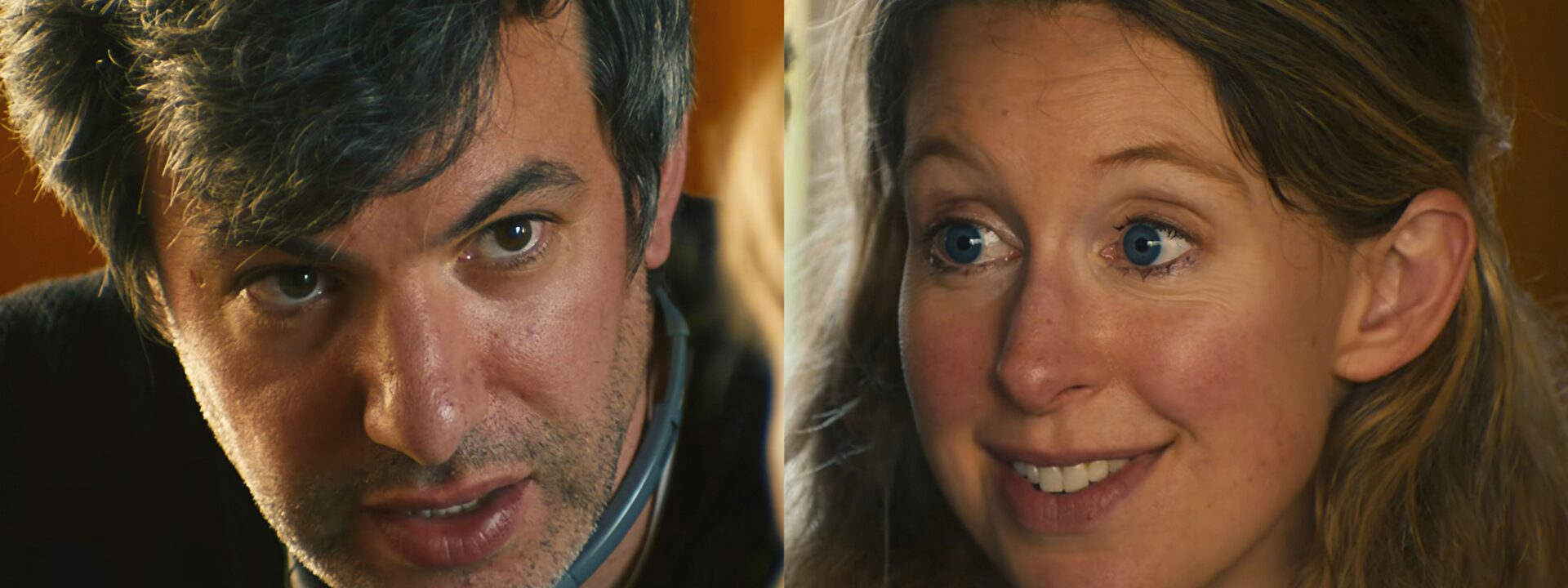
You Can See Everything, Nathan Fielder and Lance Oppenheim’s bewildering new Elizabeth Holmes documentary, had its surprise world premiere at the Telluride Film Festival on September 6. But it was the film’s first teaser trailer, released the same day, that got the wider public talking. In it, Fielder and the disgraced biotech entrepreneur—then just weeks away from entering prison for fraud—are seen in a beach house, seated very close together. “I can promise you that. I don’t have anything to deceive you on. Of course I’m not deceiving you,” Holmes says. “I’m engaging with you as a human being. Why would I deceive you? There’s no reason for me to do that.” “Okay. Alright. Okay, good chat,” comes Fielder’s reply. Then, after a few beats: “You’re being real right now?” “I’m always being real,” Holmes says. All the while, the two are locked in a staring contest like two territorial bald eagles in a death spiral. The clip, which runs just over a minute, has racked up 8.5 million views. Watching the teaser for the first time, I was among the many people who simply couldn’t get past their penetrating gazes. I grew up going to Texas cotillion, where I was taught that good eye contact was an important part of Southern charm. Yet what I witnessed in that scene was almost aggressively unpleasant. So, what was the difference? The answer, according to etiquette expert and author Elaine Swann, was partly a matter of duration. “The golden rule I share with my clients when it comes to eye contact is to always use it in moderation,” she says. “Look at the person, but don’t stare too deeply, because then you can come off as creepy. But don’t look away for too long, because you may be perceived as elusive.” Like most social signals, the conventions around eye contact have evolutionary roots. Research has shown that mutual eye contact can trigger everything from an elevated heartbeat to arousal—but if it goes on for too long (that is, beyond 3.2 seconds, per a 2015 study), the contact shifts from being engaging to potentially threatening, suggesting a fight for dominance. “If a person holds eye contact without breaking it for an uncomfortable amount of time, it might reveal a couple of things,” Swann says. “They might lack social awareness and not recognize that their long gaze is affecting someone negatively.” At other times, however, “they may be intentionally using that long stare to intimidate someone or assert power over them.” A central question of Fielder and Oppenheim’s film is whether Holmes is really as guileless as she seems, or in fact a master manipulator. On one hand, the project as a whole leaves that call to the viewer. On the other, perhaps the very first teaser tells you everything you need to know. Have a beauty or wellness trend you’re curious about? We want to know! Send Vogue’s senior beauty & wellness editor an email at beauty@vogue.com.
Frequently Asked Questions
FAQs Contact Sports How Much Eye Contact Is Too Much
1 What counts as contact sports here
Sports where players physically touch or collide like wrestling boxing football rugby basketball and martial arts
2 Why does eye contact even matter in contact sports
It helps you read opponents anticipate moves and communicate with teammates But too much can distract you or be seen as a challenge
3 How much eye contact is normal during a match
Brief frequent glances a second or two at a time are normal You look to read the situation then look away to act
4 When does eye contact become too much
When you stare for more than a few seconds lock eyes while ignoring the play or keep staring after a play ends Thats usually too much
5 Is staring at an opponent before a match a problem
A short confident look is fine Prolonged staring can be seen as intimidation and may raise tension or draw penalties
6 Can too much eye contact hurt my performance
Yes Staring at one opponent means you stop scanning the field which slows your reactions and awareness
7 What does too much eye contact look like in wrestling or MMA
Locking eyes during a clinch or staring down an opponent instead of watching their hips or hands you lose track of their actual movements
8 How do I know if Im staring too much
If you cant remember whats happening around you or your opponent looks uncomfortable or aggressive youre probably staring
9 Is avoiding eye contact a bad sign
Not always Glancing away to scan the field is smart But never making eye contact with teammates can hurt communication and trust
10 Whats a good balance
Use quick looks to read opponents and connect with teammates then shift your eyes back to the action Think check act check again
11 Does eye contact mean the same thing in every sport
No In boxing a staredown is part of the culture In basketball or football long stares are usually unnecessary and can distract you
12 Can too much eye contact start a fight
It can In contact sports prolonged staring is often read as a challenge so it can escalate tension between players