For the third consecutive year, Vital Impacts has awarded seven environmental photography fellowships totaling $50,000, along with eleven mentorships. The recipients, selected from 526 submissions across 86 countries, are photographers who explore the intricate relationship between humanity and the planet.
Founder Ami Vitale emphasized the organization’s goal of supporting the next generation of storytellers by championing artists whose work conveys empathy, interconnection, and our shared responsibility toward ecosystems. “We aspire to create opportunities for these emerging voices to explore complex environmental issues with originality and nuance at this critical moment,” she said.
The eleven photographers awarded year-long mentorships will work one-on-one with established photographers, editors, and conservationists, gaining the opportunity to tell stories that celebrate both people and the planet.
“Each of these artists moves between rigorous documentary photography and artistic exploration, always with a deep ethic of care,” said Alessia Glaviano, Head of Global PhotoVogue and Director of the PhotoVogue Festival, who served on the judging panel.
This year’s jury also included:
– Azu Nwagbogu, Founder and Director of the African Artists’ Foundation and Lagos Photo Festival
– Evgenia Arbugaeva, National Geographic Storytelling Fellow and Academy Award nominee
– Kathy Moran, Deputy Director of Photography at National Geographic
– Pat Kane, Vital Impacts Environmental Jane Goodall Fellowship winner
The 2024 Fellowships
$20,000 Environmental Photography Fellowship
‘Terra Vermelha’ – Tommaso Protti, Brazil
A decade-long investigation into deforestation and Indigenous resilience in the Brazilian Amazon.
Caption: Kanamari children, originally from various villages in the Vale do Javari indigenous territory, find themselves stranded in a makeshift camp on the banks of the Javari River in Atalaia do Norte.
Dr. Sylvia Earle Environmental Photography Fellowship
“Te Urewera: The Living Ancestry of the Tūhoe People” – Tatsiana Chypsanava, Nelson, New Zealand
A project celebrating the Tūhoe people’s revolutionary model of stewardship, which recognizes the land as a living ancestor.
Caption: Children from the Teepa family drive their younger siblings home after a swim in the Ōhinemataroa (Whakatane) River in Ruatoki, New Zealand. Tūhoe children are taught independence and to care for other family members.
Hindou Oumarou Ibrahim Environmental Photography Fellowship
“Beyond the Steppe” – Cléa T. Rekhou, Algiers, Algeria
A project showing how the ancestral knowledge and collective innovation of desert communities are revitalizing landscapes.
Caption: A goat and its lamb in the midst of a developing sandstorm, “El Ghbar,” as it sweeps over a family tent settlement in the middle of the steppe.
Ian Lemaiyan Environmental Photography Fellowship
“The Cost of Coal” – Supratim Bhattacharjee, Kolkata, India
A project denouncing the human and ecological toll of coal mining in India.
Caption: Beauty Devi (34) sits in her village in the evening after burning coal. Many abandoned mines with leftover coal were left unsealed and unsafe.
E.O. Wilson Environmental Photography Fellowship
“A Boat for the Future of the Mountains” – River Claure, Cochabamba, Bolivia
In River Claure’s work, totora reed boats become symbols of memory and resistance amid the disappearance of Andean waters.
Caption: Doña Flora lies down on her granddaughter’s lap.
Madonna Thunder Hawk Environmental Photography Fellowship
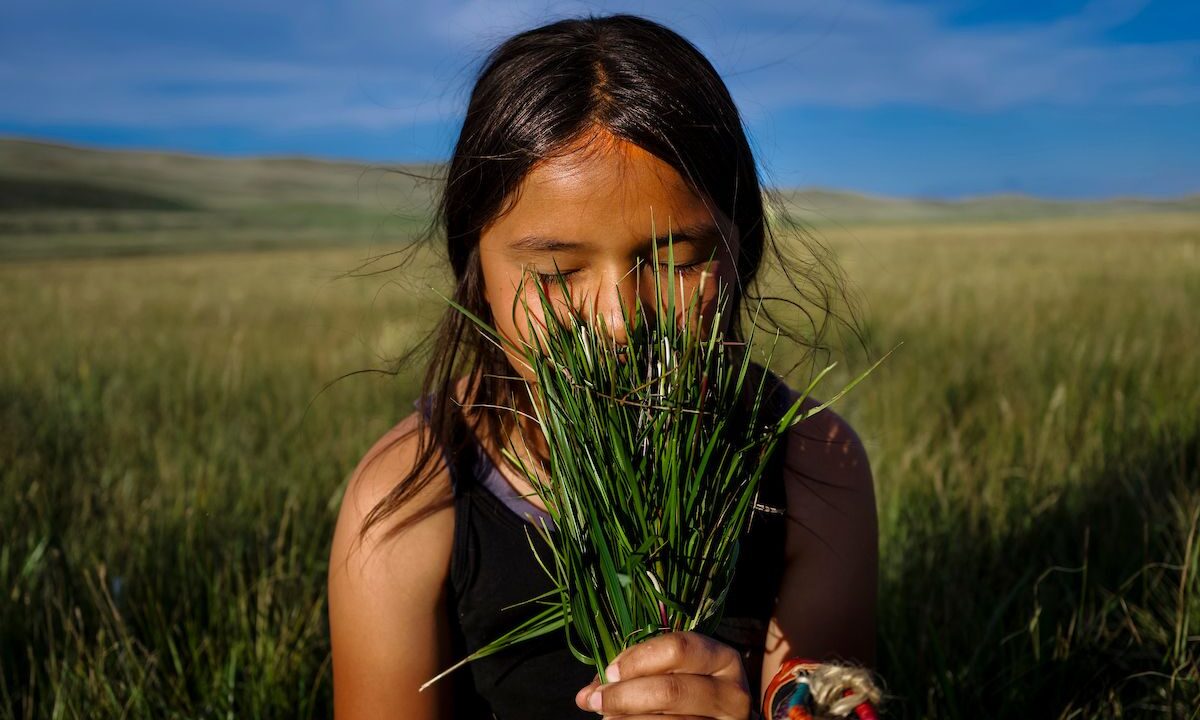
“The Women’s Grass” – Whitney Snow, Heart Butte, United States
A project documenting women of the Blackfeet Nation restoring sacred sweetgrass and preserving its teachings for future generations.
Caption: A young Blackfeet girl smells freshly harvested sweetgrass, connecting with a plant now under threat from drought and overgrazing.
Chico Mendes Environmental Photography Fellowship
“Beyond the Lake” – Carlos Folgoso Sueiro, Verin, Spain
An exploration of rural Galicia, where communities…Communities face drought, wildfire, and depopulation while holding on to memory and place.
Nacho, 40, is originally from Zaragoza, nearly 1,000 kilometers from Galicia. After a turbulent youth, he chose to isolate himself in the Galician mountains to live with less dependence on society. Today, he tends his herd of goats, sharing a special bond with them—he hugs them, talks to them, and cares for them like children. Each morning, he takes them to the mountains early to graze and doesn’t return until nightfall. In these animals, he has found meaning in his life. Nacho lives in an old, occupied stone house without electricity, surviving on vegetables and his goats’ milk. He says his dream is to eat like the goats, living off the mountain herbs. Leading a hermit-like life, he finds true freedom in this self-imposed exile from mainstream society.
May 24th, 2024. Vilar, Galicia.
Carlos Folgoso Sueiro
The 2026 Mentees
Bade Fuwa, Nigeria
I captured a hand holding a dead bird found in the landscape in Luben, Germany, 2025. The image speaks to disposability—how lives, objects, and beings are often abandoned once they no longer serve a purpose. By preserving the bird within the frame, I wanted to give it a home and a reason to be remembered forever. The photograph becomes a gesture of care, allowing it to be seen, remembered, and held beyond its moment of death.
Bade Fuwa
Selene Magnolia Gatti, Italy-Germany
May 2023, Lugo, Emilia-Romagna, Italy. Pigs that survived in a pig factory farm severely affected by floods. Canals and rivers in the area overflowed after heavy rains and extreme weather. The floods followed years of severe drought, which compacted the soil and reduced its ability to absorb rainfall. Factory farms can create biological health risks during weather-related catastrophes. Flooded factory farms contributed to severe water contamination with pollutants and wastewater.
Selene Magnolia Gatti
Afzal Adeeb Khan, India
Children of the Diyara river island make their own joy, swinging on makeshift swings hung from trees.
Afzal Adeeb Khan
Isaac Nico, India
A Tamil Muslim fisherman stands on the coast of Mannar. As a member of a community historically denied land rights, his identity symbolizes resilience in the face of systemic marginalization—a vulnerability now compounded by coastal erosion and dwindling fish stocks that threaten his only livelihood.
Isaac Nico
Uma Nielsen, Argentina
Humberto Carrillo guides his llamas by the dry Laguna Guayatayoc. In Alfarcito, raising llamas supports the family and community economy. Families practice transhumant herding, moving between different wetlands across communal lands where the best pastures are concentrated. Laguna de Guayatayoc on July 7, 2025.
Uma Nielsen
Ana Palacios, Spain
Five-day-old Armonia, at the Gaia sanctuary, was rescued from being sent to the slaughterhouse; she has a fractured tibia, and her owners couldn’t care for a sick sheep. As of October 2020, Gaia houses 169 sheep and goats out of 534 rescued farm animals. All were saved after being abandoned or seized by police. Each animal has a name and a sponsor who covers food and veterinary costs. These sanctuaries receive no public funds and rely entirely on private donations. Gaia has about 2,000 members or sponsors who contribute the roughly €30,000 needed monthly to cover expenses. Armonia will remain at the sanctuary until she dies a natural death, like all the animals here.
Ana Palacios
Viktoria Pezzei, Germany
Students Michelle Korn and Johan Bolle note the direction of a transmitted bat’s bearing at specific time intervals. Triangulation requires taking bearings…Recordings from various locations near a specific roost, all taken at the same time of day.
Viktoria Pezzei
Maria José Rojas, Colombia
Amid play and laughter, Gunseya slipped into a hollow in a large rock along the Don Diego River—a space that fit her perfectly.
Maria José Rojas
Roun Ry, Cambodia
A fisherman displays a handful of sea snails caught in Trapeang Sangkae, a fishing community in Kampot, Cambodia, 2023.
Roun Ry
Jalal Shamsazaran, Iran
On July 27, 2018, in Dashtyari, Baluchestan, Iran, a young boy cleans a water reservoir with his friends. The reservoir must be kept clean. Due to drought, the village has no drinking water for people or livestock. Every two weeks, water trucks arrive from distant places to fill these reservoirs. With the ongoing drought, most villages in the region must now buy water, adding a financial burden. The open reservoirs are exposed to pollution, so the water must be boiled before drinking. Years of drought have severely limited access to safe, clean water for the people here.
Jalal Shamsazaran
Michaela Vatcheva, Bulgaria
In Novi Sip, Serbia, on Friday, October 25, 2024, Lyba Duranovic checks whether a sterlet accidentally caught in his net overnight is still alive. Sterlets are the smallest of the four native sturgeon species in the Danube and the last still inhabiting the Middle and Upper Danube, as they do not migrate to the Black Sea. Their population has declined sharply, largely due to the degradation of their main habitats, spawning grounds, and feeding areas.
Michaela Vatcheva
Frequently Asked Questions
Frequently Asked Questions Vital Impacts Fellowships Mentorship 2026
General Definition Questions
1 What is the Vital Impacts Fellowship and Mentorship program
Its a prestigious program that awards selected photographers with funding professional mentorship and a platform to complete a meaningful environmental or social justice storytelling project
2 Who are the Awarded Photographers for 2026
They are the group of photographers selected for the 2026 program cycle Their names biographies and project descriptions are announced on the Vital Impacts website and social media channels
3 Is this a grant a fellowship or a mentorship
It combines all three Its a fellowship that provides a financial grant to support the project paired with a structured mentorship from industry leaders
Application Eligibility
4 Who can apply for this fellowship
The program is typically open to photographers globally from emerging to midcareer professionals who have a compelling project idea focused on positive environmental or social impact Specific eligibility criteria are published in the annual call for applications
5 When do applications for the next cycle open
Application timelines vary The best way to know is to sign up for the Vital Impacts newsletter on their website which announces all deadlines
6 What makes a strong application
A clear impactful project idea a demonstrated commitment to the subject a strong portfolio showing your photographic skill and a wellthoughtout plan for how youll use the fellowship and mentorship
Benefits Program Details
7 What do the awarded photographers actually receive
Benefits usually include a monetary award oneonone mentorship with renowned photographerseditors networking opportunities and promotional support to showcase their completed work
8 Who are the mentors
Mentors are typically acclaimed photographers photojournalists photo editors and other visual storytelling professionals Their names are often announced alongside the fellows
9 Do photographers get their work published or exhibited
Yes a key part of the program is to give the projects a public platform Vital Impacts often organizes exhibitions publishes books or features and promotes the work through media partnerships
For Beginners Aspiring Applicants