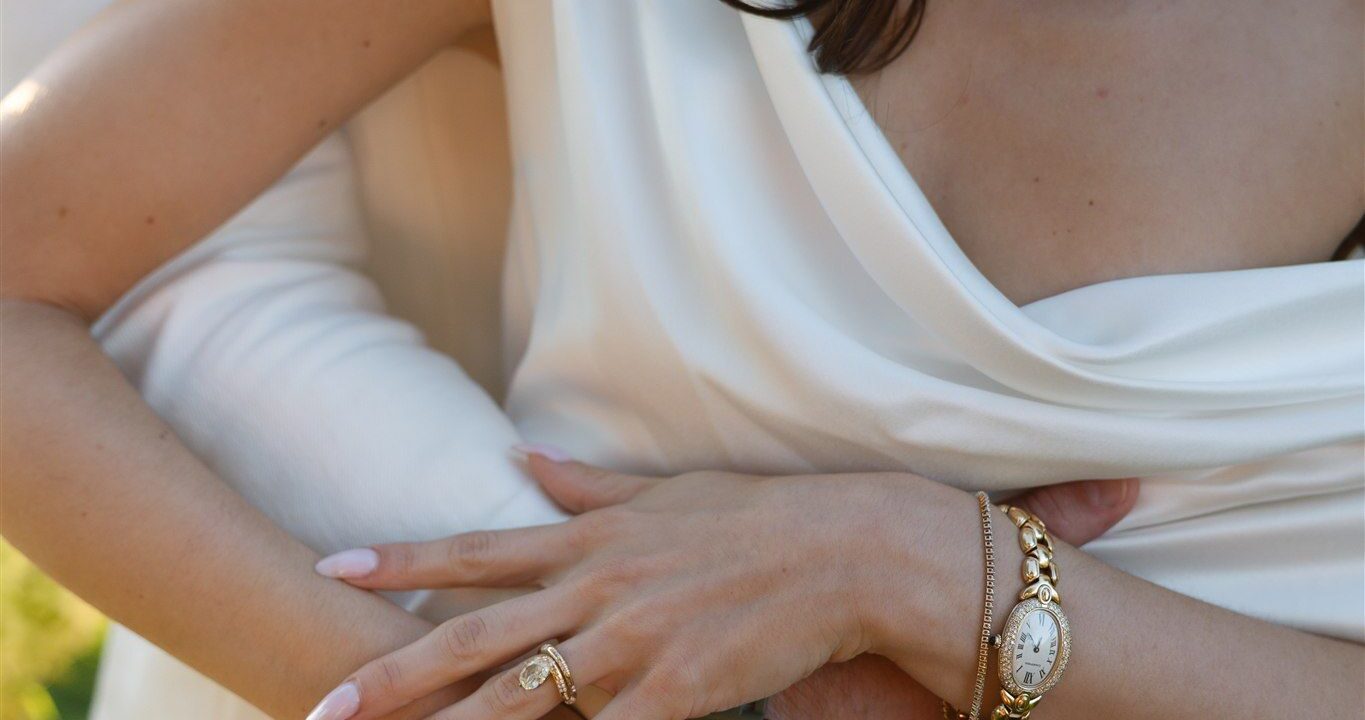
When it came time for Kira Kirby to get engaged, she knew the ring—and especially the diamond—had to be anything but ordinary. As a jewelry influencer with a love for the finer things, she already had a clear idea of what she wanted on her left hand: something unexpected, definitely vintage, and not perfectly white.
So, with a little guidance from Kirby, her fiancé proposed with a custom Dyne ring featuring a three-carat, old-mine brilliant-cut diamond. Instead of going with the usual icy, colorless diamond that’s become the standard for engagement rings, the couple chose a butter yellow, W-X color stone sourced by designer Sarah Ysabel Narici. “Our designer told us, ‘This is a one-of-a-kind stone. You’re not going to find something like this again,’” Kirby recalls. “When I saw it in person, I completely understood.”
Kirby isn’t the first bride-to-be to say yes to a warm-toned diamond—remember Scarlett Johansson’s 11-carat light brown rock from Colin Jost in 2019? But lately, it’s hard to miss the growing number of fiancées showing off glowing, tawny-colored stones. Often called candlelight, desert, or champagne diamonds, these romantic gems are “really having a moment right now,” says Sherry Shi, co-founder of New York City-based jewelry atelier Roen. Bespoke jewelry designer Izzy Galler of Izzy Atelier estimates that nearly 95% of her engagement ring requests are for warmer stones. Interest in champagne diamonds has “come back really strongly,” says Page Neal, co-founder of Bario Neal—so much so that the jewelry studio recently brought the gems back into its collection.
It’s no surprise these once-overlooked stones are gaining popularity. Sometimes ivory, sometimes caramel, and occasionally a little peachy, these diamonds are both striking and still largely unconventional—making them the perfect choice for a future fiancée who wants to break tradition with a truly unique diamond. “We’re in a world of AI, lab diamonds—everything is very quick, easy, efficient. Everything’s perfectly optimized,” says Melody Baek, founder of Los Angeles-based jewelry brand Solairé. “Now, people want something that feels unique, something that has character, personality, and isn’t actually ‘perfect.’”
On paper, Kirby’s stone—like most champagne diamonds—probably wouldn’t catch the eye of a more traditional shopper. Decades after diamonds became the default engagement gemstone, the goal has been not just to get the biggest stone, but the whitest one. While colorless and near-colorless stones usually fall in the D to J range on the standard GIA diamond color scale, champagne diamonds tend to sit in the historically less desirable M to Z range. Unlike fancy yellow or brown diamonds—which sometimes fall into this category—champagne is purely a marketing term, or a “poetic umbrella,” says Shi. So, the label is often based on appearance; “[It] really refers to any diamond that has warmer, pinkish, brownish, yellowish undertones,” says Kegan Fisher, co-founder and CEO of Frank Darling.
Nearly every jeweler I speak to points to De Beers’ Desert Diamonds campaign when discussing the rise in demand for these stones. Launched in late 2025, the campaign aimed to revive interest in earthy-toned, natural diamonds as colorless, lab-grown stones became more common. And it’s working: natural diamond sales in the K to Z color range were up 19% as of Q1 2026, according to a company release in May. Alongside this is a renewed enthusiasm for antique diamonds—“Thank you, Taylor Swift!” says Fisher. Not all chaChampagne diamonds are antiques, but most of the centuries-old inventory available tends to be warmer in color, explains jewelry designer Arielle Ratner. Plus, choosing a lower color grade “leaves more room in the budget to maybe go up in size or clarity,” she adds, though price is usually a bonus rather than the main reason. “I’ve had multiple clients with big budgets who could do anything, but they choose something that feels more unique,” says Galler.
A champagne diamond ring design by Arielle Ratner.
Photo: Courtesy of Arielle Ratner
Indeed, whether it’s from social media fatigue with sameness or burnout from bright white diamonds, there’s a growing focus on personalizing engagement rings—and a champagne stone is a great starting point. For her ring, Megan Downs kept it classic with a solitaire setting, but chose a champagne lab-grown marquise diamond that “screams me,” she says, after trying on countless “underwhelming” colorless diamonds.
Megan Downs with her champagne diamond engagement ring.
Apple Photos Clean Up
Meanwhile, Emma Rose Léger picked two natural champagne stones—an antique-cut, S-T color oval and an old-mine brilliant-cut fancy brown-yellow cushion-cut—to create her toi et moi engagement ring. She sees this one-of-a-kind piece becoming her and her fiancé’s “first family heirloom.” And while the content creator has noticed more champagne diamonds appearing on her social media feeds, “nothing comes close to what my ring looks like, which I really love,” she says.
Emma Rose Léger with her champagne diamond engagement ring.
Photo: Courtesy of Emma Rose Léger
Even if someone tried to copy Léger’s ring, it would be nearly impossible because champagne stones “all really have their own fingerprint,” says Shi. “It’s not like if you came in and said, ‘I want a D-color round,'” explains James Ding, fellow Roen co-founder. “[I could] give you five of them that look exactly the same.” That’s why Galler compares a warm diamond to “a little piece of art.” “When you see something and think, ‘That’s mine,’ you’ll likely never see anything exactly like it again,” adds Shi.
While some assume that choosing a lower color grade means sacrificing quality, Ratner quickly clears that up. “[Color] has nothing to do with quality. A diamond can sparkle just as much, if not more, even if it’s slightly lower in color.” Similarly, just because a diamond has “amazing grading” doesn’t mean a client will feel a connection to it; “I have to have an emotional feeling when I look at it,” she notes. If Kirby had judged her diamond only by its stats, she might have passed on it. “But numbers on paper don’t compare to the look and feel of a stone,” she says. Because of these nuances, it’s worth having the person being proposed to involved in the process. The jewelers I spoke with agree that designing an engagement ring—especially with a champagne diamond—as a complete surprise is rare these days.
Frequently Asked Questions
Here is a list of FAQs about Champagne diamonds as the next big trend for coolgirl engagement rings
Beginner Questions
1 What exactly is a Champagne diamond
Its a natural diamond that has a warm brownishyellow color ranging from light cognac to a deeper richer honey or whiskey shade Think of it as the diamond version of your favorite caramel latte
2 How is it different from a regular white diamond
The main difference is color White diamonds are graded on a lack of color Champagne diamonds are intentionally chosen for their warm earthy hue They also tend to be more affordable than a comparable white diamond of the same size and clarity
3 Why are they suddenly so popular for engagement rings
They offer a unique vintageinspired look without the high price tag of a white diamond Theyre perfect for the cool girl who wants something different edgy and personalnot the standard solitaire everyone else has
4 Are Champagne diamonds real diamonds
Yes 100 They are natural diamonds just with a higher concentration of nitrogen during their formation which gives them that goldenbrown color
5 Do they sparkle as much as white diamonds
They sparkle differently Because the stone has more color the sparkle is warmer and softermore like glowing embers than a flash of lightning Some people prefer this subtle romantic fire
Advanced Questions
6 What do the color grades mean for Champagne diamonds
Theyre not graded with the standard DZ scale Instead youll see terms like Fancy Light Fancy Fancy Dark and Fancy Deep Fancy Light is a pale champagne while Fancy Deep is a rich dark cognac The intensity of the color directly impacts the price
7 Are they more durable than white diamonds
No All diamonds rate a 10 on the Mohs hardness scale so a Champagne diamond is just as durable and scratchresistant as a white one Perfect for everyday wear
8 Will a Champagne diamond look dirty or dull over time
Like any diamond it can collect oils and dirt However the warm color actually hides dirt better than a white diamond so it wont look as cloudy as quickly A simple soak in warm soapy water and