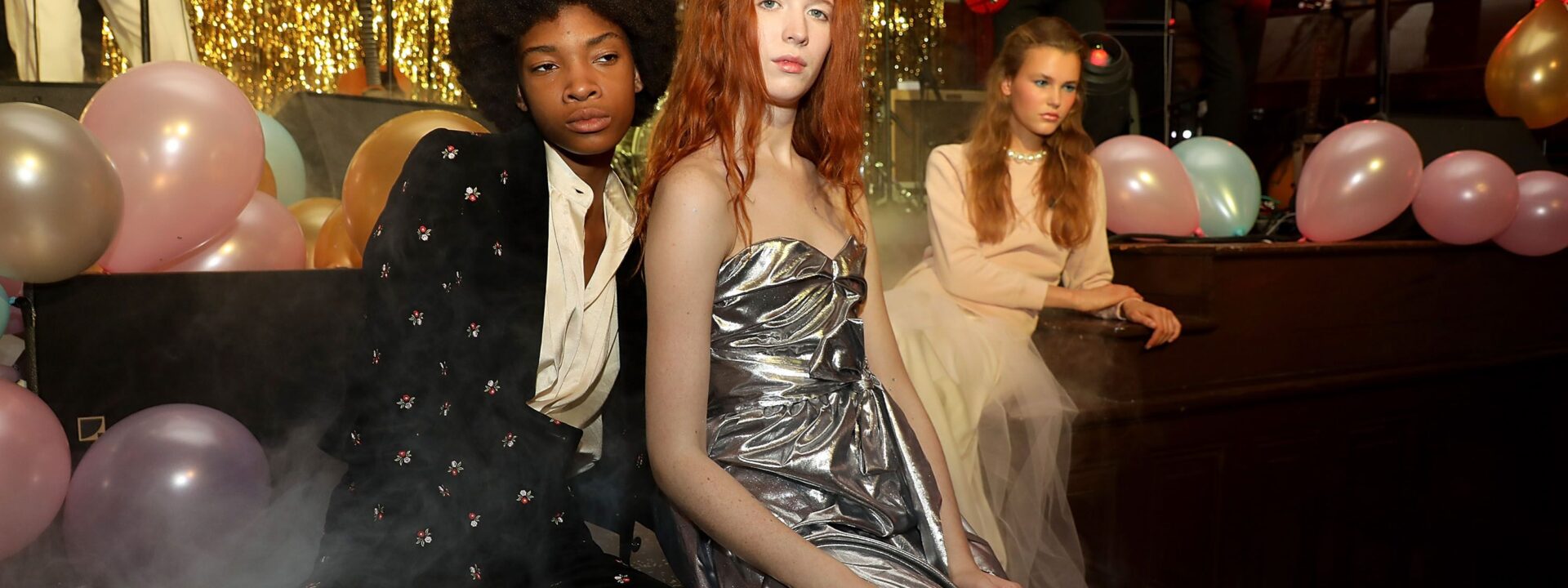
On any given Saturday morning in January, a line of high school juniors and seniors forms outside Miss Priss, a specialty prom boutique in Lexington, Kentucky. Some girls have driven four to five hours from rural towns, arriving before the store opens at 10 a.m. to get in line. Others have flown in from as far as Washington State. The owner, Elizabeth Cruse, will sell more than 100 prom dresses before the day ends.
Cruse has run Miss Priss since 2003, long enough to now dress the daughters of women she once dressed as teens. Her website warns customers that on busy days, she operates “like a restaurant”: the wait for a dressing room can stretch to three hours during peak prom-fitting season, which Cruse says is in January. “The day after Christmas is when prom season starts here,” she says. Most girls come with their parents or grandparents, so once they’ve picked out dress options, they use the time for a long family lunch before being called back to the fitting room.
High school girls across the country—in Wisconsin, Plano, Atlanta—are doing the same thing throughout the winter months. According to Sherri Hill, founder and designer of her namesake brand, some customers start visiting their local prom retailer as early as November, especially if they’ve booked a design consultation for a custom-made gown. Hill travels to many of her retailers for these custom orders, which can cost more than $4,000.
“When I was a kid, you looked at prom dresses in teen magazines,” says Casey Lewis, who writes the Gen Z trend-focused newsletter “After School.” “I knew the cool dresses from what was in Seventeen. None of these brands were direct-to-consumer or sold at a mall store, or even, in many cases, a department store. You could only get them at wedding or formal boutiques.”
More than two decades later, tween magazines may have faded, but prom-goers are still shopping in-store. “In-person shopping isn’t really a thing anymore, except for prom,” says Reagan Smith, a senior at Plano Senior High School in Texas, who mostly shops brands like Free People on sites like Anthropologie. Smith bought her prom dress at Terry Costa, a Dallas-area boutique where Sherri Hill is the dominant brand.
Traditional wholesale prom dress brands, such as Sherri Hill, Jovani, and Ashley Lauren, still dominate #PromTok, despite competition from newer, TikTok-native brands like Princess Polly and Lulus. Lewis, who scrolls TikTok professionally to track Gen Z behavior, spent weeks this year studying the PromTok space. “I’ve taken notes on some of the labels,” she says. “And they’re all very traditional prom retailers who previously didn’t have any direct-to-consumer presence at all.”
The wholesale boutique model might sound like a nostalgic ’90s throwback, but the data shows it’s still working, at least for now. According to Andrew Roth, CEO of Gen Z research firm Dcdx, the three legacy houses—Sherri Hill, Jovani, Ashley Lauren—accounted for 96.4% of branded TikTok engagement across nine major prom-adjacent labels tracked between February 2023 and May 2026. Sherri Hill alone made up 82.4%. The other labels tracked were Mac Duggal, Faviana, Revolve, Lulus, Princess Polly, and Anthropologie.
“We’re not even thinking about going direct-to-consumer at this point,” says Hill, who has reported double-digit annual sales growth for three consecutive years, a cumulative increase of 64.3% since 2022.
The yearly routine hasn’t changed much since the designer started making dresses in 2008: twice a year, Sherri Hill, along with the other legacy prom houses, meets at AmericasMart in Atlanta, where three full expo floors are dedicated to prom. Retailers, like Cruse of Miss Priss, attend in August to place orders for the following year’s proms, and in April for homecoming.
For the model to work, the wholesaler-boutique relationship needs to be strong.Hill and Cruse explain that the key is maintaining a perfect balance. Hill promises exclusivity to her boutiques—for example, another Sherri Hill retailer wouldn’t be allowed to open near Miss Priss—and in return, Cruse sells her dresses.
“Honestly, it’s just the model that works. We’ve found this is what works best for us,” says Liza Greenberg, who has worked with Hill for a decade, starting as a prom dress model and now running sales for the brand.
Hundreds of miles north, in Manhattan’s Garment District, Abraham Maslavi runs the showroom for Jovani, the prom and bridal company his father founded in 1983. According to Felicia Garay-Stanton, who handles PR for the brand, Jovani sold over 107,000 prom dresses this season alone. Prom makes up about 40% to 45% of Jovani’s yearly sales; evening wear and mother-of-bride or groom collections account for another 40%, with the rest going to homecoming, bridal, and couture.
Jovani’s prom dresses can cost up to $5,000 (the average dress is $900; by comparison, many styles from e-tailer Princess Polly are only $100). But according to the designer, some of the brand’s strongest sales come from lower-income areas like West Virginia, Arkansas, and Mississippi. Even though per capita incomes there are well below the national average, the tradition of attending prom is strong. “West Virginia is the poorest state per capita,” Maslavi says. “We sell so many dresses there. I’ve always been puzzled. But it’s really about everyone helping that prom girl at this moment in her life to get the best dress. The whole family chips in.”
Economist Jay Zagorsky, a professor at Boston University’s Questrom School of Business, has tracked the cost of attending prom—dress, suit, shoes, hair, nails, dinner, transportation—since 2014, after being surprised by the ticket prices for his own kids. To many parents’ surprise, he’s found that prom has stayed one of the more affordable traditions, rising about 47% since 2000, compared to a 93% increase in the consumer price index. However, in 2026, tariffs caused dress prices to jump by around 10%. Maslavi says tariffs on imported fabric from China and India were as high as 50%, forcing Jovani to raise retail prices by about 20%—its first significant price increase in roughly a decade. The brand absorbed the rest of the tariff cost itself.
Customers still came through. Emma Wendt, a high school senior from Abbotsford, Wisconsin, found her $900 Sherri Hill dress marked down to $500 at JP Togs and worked out a payment plan with the owner. She paid for half with money from her job at a childcare program, and her mother covered the rest. “I paid for half, so I don’t feel as guilty for buying such an expensive dress,” Wendt says.
A trendless prom season
If there’s one defining trend for prom dresses in 2026, it’s that there isn’t one. Cruse at Miss Priss, Greenberg at Sherri Hill, and Maslavi at Jovani all agree that this year, no particular style is in high demand. Last prom season, though, had a single viral dress that made headlines—a corseted floral ball gown that Sherri Hill reportedly sold tens of thousands of. “Girls were doing anything they could to get their hands on it,” says Greenberg.
Lewis also isn’t seeing many vintage or thrifted dresses on PromTok. “You’re not seeing the girl in the beautiful vintage dress, the Jackie O dress, or something like that,” she says. And despite it being “the most iconic prom movie ever,” girls today don’t go for Julia Stiles’s expressive, grunge prom look from 10 Things I Hate About You either. “I honestly don’t think prom is one of those nights where you want to be too individual. It’s a fine line, kind of like high school itself. They express themselves through color or details, but at the same time, so many of these girls are dressing pretty much the same.”
While vintage prom dresses haven’t become mainstream yet, Lewis has noticed a rise in resale driven by PromTok.”I’ve seen so many girls ask, ‘Will you rent this to me?’ or ‘Will you sell this to me?'” she says. “And when they do get replies, it’s always like, ‘No, I’m not selling; I’m keeping it.'”
On TikTok, the peer-to-peer rental platform Pickle reports that prom-related rentals have jumped 199% compared to last year, prom searches are up 216%, and listings have increased by 143%. But Pickle’s most-rented prom dresses come from designers you’d find on sites like Revolve or Fwrd, rather than traditional prom stores: Manning Cartell, Zimmermann, Andres Otalora, and Nookie.
For now, most teen prom resale happens outside of these platforms. Smith sold last year’s prom dress to a girl at her school. In Wisconsin, Wendt’s friends post their dresses on Snapchat with a price and a caption like “text me if you want this dress.” Some boutiques, including JP Togs, have started back-rack consignment programs where a customer from the previous year can return her dress for half its resale value. Sherri Hill, however, doesn’t allow any of its boutiques to rent its dresses. “I think allowing rental cheapens the brand,” says Cruse.
According to Lewis, there’s a real opportunity for brands and marketers in paid prom content. Neither traditional fashion houses nor e-commerce brands have gotten into prom dress gifting or sponsorships. “Most of it happens naturally,” Greenberg says about Sherri Hill’s presence on TikTok. Jovani started its Instagram in 2012 as a platform for user-generated content and runs the It Girl program (a modeling contest that also serves as ambassador development), but it hasn’t yet set up paid creator partnerships on a large scale.
Affiliate revenue for prom attendees is another untapped opportunity. Lewis has noticed that girls are asking in TikTok comments where others got their prom dresses, and while creators might tag the brands, they rarely earn any affiliate commission. This year, LTK’s prom affiliate revenue went to Revolve, Nordstrom, Lulus, and Target. Sherri Hill and Jovani weren’t on the list.
“It’s only a matter of time,” Lewis says, before brands start treating PromTok as a real opportunity. “I feel like this is the year brands will wake up to prom, kind of like they woke up to RushTok. And then next year, the landscape will look very different.”
Frequently Asked Questions
Here is a list of FAQs about Brands should consider going to prom written in a natural tone with clear concise answers
BeginnerLevel Questions
1 What does it mean for a brand to go to prom
It means a brand sponsors partners with or creates a campaign around high school prom season This could be anything from hosting a contest to providing free dresses tuxedos or makeup to setting up a photo booth at a school event
2 Why would a brand want to be associated with prom
Prom is a huge emotional milestone for teens Its a time of excitement anxiety and social pressure A brand that helps make that night easier or more memorable builds strong positive feelings and loyalty with a young audience
3 Is this only for fashion or beauty brands
No While beauty and fashion are obvious fits any brand that targets teens can get involved Examples include snack companies tech brands car companies or even banks
4 Whats the easiest way for a small local brand to get involved
Partner with a local high school or a community prom dress drive You could offer a discount to students with a prom ticket sponsor a best dressed contest on social media or provide free samples for promgoers
Advanced Strategic Questions
5 How does prom marketing differ from backtoschool marketing
Backtoschool is about necessity and utility Prom is about aspiration social status and emotion Prom marketing needs to be more glamorous shareable and sensitive to the social pressures teens face
6 What are the biggest risks a brand should watch out for
The main risks are being seen as inauthentic or trying too hard Teens can spot a cash grab from a mile away Also you need to be careful with inclusivitymake sure your campaign represents different body types budgets and gender expressions
7 How can a brand measure success from a prom campaign
Look beyond direct sales Track social media engagement brand mentions during prom season website traffic and signups for contests or giveaways The